Updated July 2023
Now that almost all public transport users in Victoria have to use the trouble-plagued Myki ticketing system, people need simple answers to basic questions about it. This page is an effort to explain how the Myki system works, and answer the main questions we are asked.
Where can I get a Myki?
Cards can be obtained online or by phone (1800 800 007 6am – midnight daily). You can also get them from Myki Card Vending Machines (which are located at railway stations, some tram platform stops, and some major bus interchanges), from staff at Premium (staffed) stations, staffed V/Line station (within the Myki boundary), or from PTV Hubs, which are at Southern Cross station, Westfield Shopping Centre, Geelong, and Bendigo Marketplace, Bendigo.
Mykis can also be purchased at many metropolitan retail outlets and some country retail outlets, particularly, but not exclusively, 7-Eleven stores, as well as some Australia Post outlets in major regional centres. See here to get the location details of retailers selling Myki.
V/Line conductors sell full-fare or concession Mykis, pre-loaded with Myki Money, for travel to and from V/Line stations between Melbourne and Geelong, Ballarat, Bendigo, Traralgon and Seymour.
Note that only full-fare Mykis can be purchased from Myki vending machines. Concession, child and seniors Mykis must be bought from the other outlets listed above.
Also note that bus drivers are no longer able to sell or top up Mykis.
How much does getting a Myki card cost?
The cost of a card is $6 full fare, or $3 concession. The purchase price is not refundable. People who become eligible for a free Seniors Myki should apply for one as part of their application for a Seniors Card.
Note that Myki Card Vending Machines only dispense full-fare cards. Concession, child and Seniors cards can be obtained from staffed railway stations, retail outlets, at a PTV Hub, or online. More information on where to get a Myki card.
For those with compatible phones, Myki Mobile is free. See below.
Where can I add money to my Myki card?
You can top up your Myki at all the places where you can buy a card, except for locations in regional Victoria that only sell myki cards pre-loaded with some credit.
Bus drivers no longer sell or top up Myki cards.
Why can’t I get a short-term ticket?
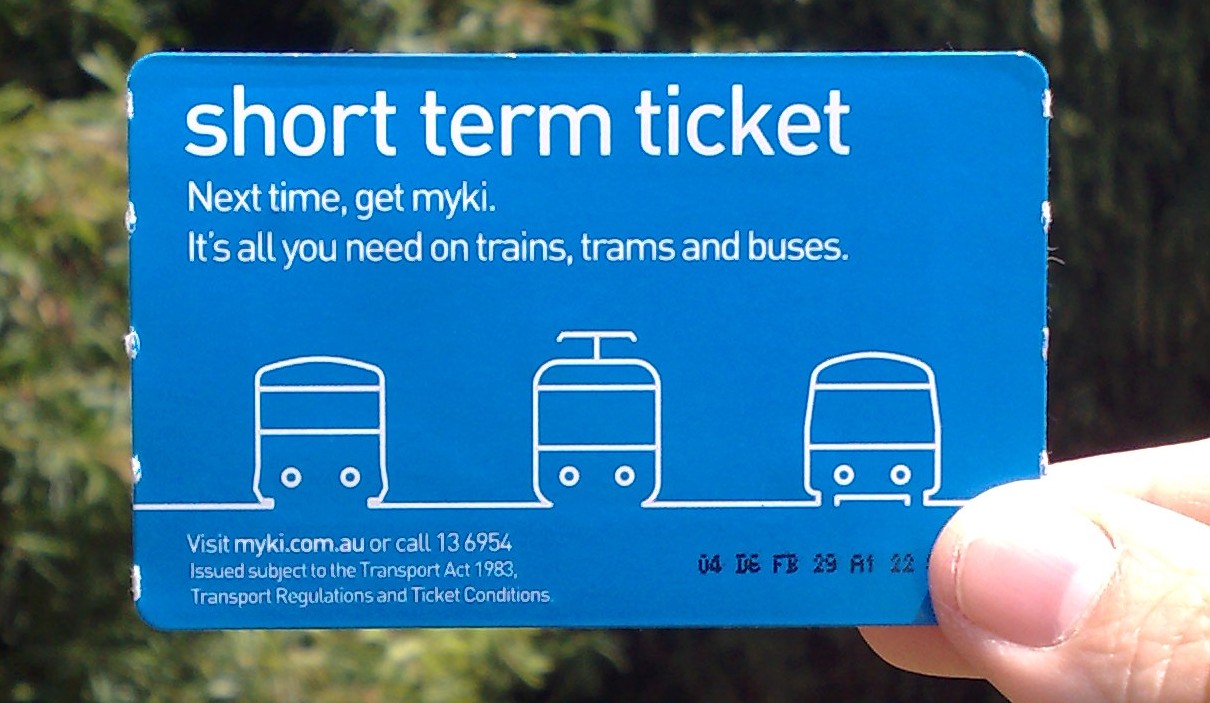
A short-term ticket (pictured) was going to be available if you didn’t have a Myki, but for reasons never explained, the state government decided that short-term tickets would not be introduced in Melbourne, and they were then abolished on regional city bus networks.
With no short-term alternative, anyone wanting to use public transport in Melbourne must have a reusable Myki card with sufficient credit loaded on it, even if they only travel every now and again.
That ridiculous decision means that the PTUA receives regular complaints about the difficulty occasional travellers have in trying to get or use a ticket.
Even regular public transport users can strike problems. If they forget to have their Myki with them they have to buy another one and put money on it. If their Myki becomes defective, unless they can get to a staffed railway station or PTV Hub, people have to wait for up to ten business days for a new Myki to be issued to them. In the meantime, if they want to travel they have to buy another card and put money on it.
The convenience of short-term tickets is obvious. Before their abolition on major regional city bus networks in mid-April 2013, up to sixty percent of passengers were using them.
How does Myki Money work?
Note: Fares increased by almost 9% on 1 July 2023. For the first time in seven years, regional town bus fares also increased, to $2.60 for a two-hour fare or $5.20 for a daily fare.
You buy a re-usable Myki card and load credit onto it. As you travel you touch on and touch off, and the system will debit your Myki card as you go. Melbourne metropolitan fares are shown in the following table. Regional fares differ from this. For full details of fares see the relevant page of the PTV web site.
| Zones | 1 | 2 | 1 and 2 |
|---|---|---|---|
| 2-hour | $5.00 | $3.10 | $5.00 |
| Daily | $10.00 | $6.20 | $10.00 |
Concession fares are 50% of the above prices. Discounts (e.g. Earlybird free travel on trains before 7 a.m.* and Weekend Cap $7.20) apply to Myki Money.
Note that the 2-hour period is exactly that and is timed from the moment you touch on. However, if you touch on after 6 p.m., the 2-hour fare applies until 3 a.m. the next day.
A “daily cap” applies: if you make multiple trips in one day, the system charges you a maximum of two 2-hour segments, e.g. the Daily fare.
If your travel is eligible for the Weekend Saver daily fare (Saturdays, Sundays and public holidays), then Myki charges you a maximum of $7.20 per day ($3.60 concession). If you’re a Senior, the weekday daily cap is $5.00 ($3.60 on public holidays), but on weekends, Seniors receive free travel for trips entirely within one or in two consecutive zones (including within Zones 1 and 2), and on regional town bus services. Note that even though Seniors are not charged under those circumstances, they are still required to touch on and off.
*Under Earlybird there is a 15-minute grace period to allow for late trains, so Myki gives you free travel on trains if you touch on and touch off by 7:15 a.m.
How does Myki Pass work?
Note: Fares increased by almost 9% on 1 July 2023.
Myki Pass is what used to be called a periodical ticket. You buy the normal Myki card and then choose to add credit to convert it into a periodical “pass” for your chosen period — for 7 days, or anything from 28 to 365 days — for the zone or zones you want. Note that these are consecutive days, and are not related to calendar months.
So the price for a “monthly” Pass is based on a particular number of days, not on a calendar month (where the number of days varies).
Current Melbourne metropolitan fares are shown in the following table. Because travel across Zones 1 and 2 costs the same as a Zone 1 fare, Zone-1-only passes are not available. Passengers need to purchase a Zone 1 + 2 pass, which costs no extra. Regional fares differ from this. For full details of fares see the relevant page of the PTV web site.
| Zones | 1 and 2 | 2 |
|---|---|---|
| 7 days | $50.00 | $33.00 |
| 30 days | $180.00 | $118.00 |
| 325+ days* | $1950.00* | $1287.00* |
Concession fares are 50% of the above prices. Although only the 30 and 325+ day prices are listed above, you can buy a Pass for anything from 28 to 365 days. For full pricing details see the PTV web site, or the Victorian Fares and Ticketing Manual.
*Note that you can get a discounted Yearly Pass via the PTUA Commuter Club, which provides more than a 9% reduction on the retail price of a 365-day Myki Pass shown above. Commuter Club Mykis are specially-coded Myki cards which are provided free with the discounted Yearly fare.
Can I combine Myki Pass and Myki Money?
Yes. A single Myki card can have a Myki Pass for travel in your usual zone or zones, and also have Myki Money loaded on it for occasional trips into other zones, including V/Line services.
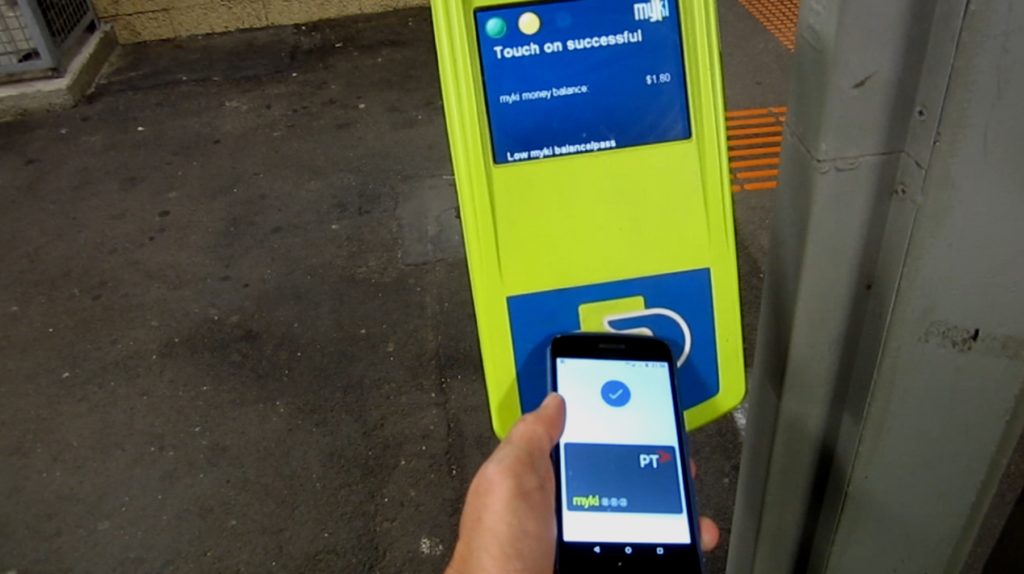
What is Mobile Myki?
Mobile Myki is a way of paying Myki fares using a mobile phone.
It is available on phones with recent versions of Android (5.0 and higher) that have NFC (Near-Field Communication). NFC is used by the phone to communicate with Myki readers so you can touch-on and off as you travel.
Mobile Myki works within the Google Pay application. You can use it to create an adult or concession virtual Myki card on your phone. Unlike a physical card, it is free, but it does need to be linked to a credit card in Google Pay. Once set up, it can be loaded with Myki Money or some types of Myki Pass.
You can then use your phone to touch on and off. The phone does not need to be unlocked, but you may need to make sure it’s “awake”.
There are more details on how to set it up on the PTV web site.
How fast is Mobile Myki for touching on and off?
Mobile Myki can be a little slow, and you need to get used to best way of touching using your phone, which is a bit different to touching a card.
The system relies on your phone’s NFC chip communicating with the Myki readers. Different phones have their NFC chip in different positions. It’s worth finding out where it is on your phone so you can hold it closest to the reader to get the quickest response.
We’ve found that, as with Myki cards, the newer card readers work better than the old green/yellow ones.
Is Mobile Myki the same as using a Myki card?
The fares are the same. You can load it with Myki Money, or some types of Myki Pass. Mobile Myki can be registered on the web site to view your travel history.
Passes on Mobile Myki can only be for 7, 28, 30, 31, 35, 40, 60 or 365 days. Mobile Myki can’t currently be used with discounted Passes, such as Student Passes, or with Commuter Club.
Unlike physical cards, topping up a Mobile Myki via Google Pay is instant. The money comes straight off the credit card you registered in Google Pay, and the new balance is written immediately onto the Mobile Myki “virtual card”.
Mobile Myki can be set to Auto Load. That works the same as Auto Top-Up on a physical Myki card – both add Myki Money when your balance falls below a value you have set. That is handy for those who use public transport regularly, but not frequently enough to use Myki Pass.
Mobile Myki should work on all Myki readers on stations, trams and buses, but it doesn’t work with Myki vending machines, nor on Myki Quick Top-up machines.
Is Mobile Myki available on iPhones?
Not yet. We understand PTV is working on it but there is no timeline.
What about paying using contactless credit cards?
That facility is available in some cities, such as Sydney and London, and is particularly useful for tourists. Unfortunately we’re not expecting this on Myki any time soon.
How does Myki work on V/Line?
Myki operates on V/Line’s so-called “commuter” services but the government has decided that Myki will not be used on what are now called “long-distance” railway services – those running beyond Geelong (Waurn Ponds), Ballarat (Wendouree), Bendigo (Eaglehawk or Epsom), Seymour and Traralgon – nor will Myki be used on any V/Line bus services. Those services continue to use paper tickets only.
The Family Traveller concession still requires a paper ticket, regardless of your destination. Available on most V/Line services, the Family Traveller allows one adult to be accompanied free by up to two children (aged 16 years and under) during off-peak times. At all other times, one child can travel free and one child needs to have a valid ticket. See here for more detailed terms and conditions.
V/Line passengers using Myki who travel in more than two zones (and that is the case for most V/Line journeys) must have:
- a Myki Pass for their entire journey and a Myki Money balance of at least $0.00; or
- a sufficient Myki Money on their card to pay for their entire journey; or
- a Myki Pass for part of their journey and sufficient Myki Money to pay for any remaining part of the journey.
V/Line Myki Pass users may travel to a destination beyond the Myki ticket area by purchasing a paper ticket extending their journey. However Myki Money users cannot use such a “hybrid” ticket. If their journey partly includes a service not covered by Myki, a paper ticket to cover their entire journey must be purchased prior to departure.
Under Myki, the concession which allows single (one-way) ticket holders one hour’s free travel in Zones 1 & 2 either side of their V/Line journey, and free Zone 1 & 2 travel all day for all other ticket types, including day return, continues to apply. Myki users must still touch on and off where required, but the Myki system will not charge anything over and above the fare already deducted. However passengers are urged to keep a close eye on their card balance to make sure the system always operates as required.
This same concession also applies to travel on the regional town bus systems on which Myki operates.
Passengers taking long journeys on V/Line commuter services are given additional time to complete their journey without incurring any extra fare. Note: Some increases in this allowance were made on 1 January 2016
- Travel across 3- 5 Zones : 2½ hours allowed
- Travel across 6-8 Zones: 3 hours allowed
- Travel across 9-11 Zones: 3½ hours allowed
- Travel across 12-13 Zones: 4 hours allowed
So a passenger who touches on in Zone 8 at 9.30 a.m. and touches off in Zone 1 at 11.15 a.m. (an 8-zone trip) pays a Zone 1-8 fare which expires at 12.30 p.m.
If touch-on occurs after 6.00 p.m. the fare does not expire until 3.00 a.m. the following day.
The discount fare for off-peak travel, which provides a 30% reduction over the normal fare, is available under Myki for all services timetabled to arrive in, and depart from, Melbourne outside the designated peak times.
To obtain the off-peak concession, V/Line passengers using Myki should not touch on at a station in the morning before the off-peak period commences. In the evening a 15-minute “grace period” applies. Although the off-peak period starts at 18:00 (6 p.m.), a passenger using a V/Line train can touch on after 17:45 (5:45 p.m.) and still obtain the off-peak fare.
For full pricing details see the relevant table in the Victorian Fares and Ticketing Manual.
Does the PTUA provide discounted Yearly tickets under the Commuter Club scheme?
Yes. PTUA members who are regular public transport users can buy discounted Yearly tickets, at about 9% off the retail price, and that includes a free Myki card. You can see full details of the offer here. Commuter Club is also available via some employers.
Note that Commuter Club is only a Melbourne metropolitan program. Even though Myki is used on V/Line commuter services, Public Transport Victoria says there is no plan to extend Commuter Club availability beyond the metropolitan area.
However, passengers travelling to Melbourne from Zone 2 stations which are only served by V/Line trains, such as Tarneit, Wyndham Vale or Melton, are eligible for Commuter Club.
Other V/Line passengers can purchase a 365-day Myki Pass at a heavily discounted rate, which includes up to 40 days free travel.
What should I do if my Myki card is lost or stolen?
If your Myki card is registered and it is lost or stolen, report that as soon as possible by calling 1800 800 007, or logging on to your online Myki account, or going a PTV Hub. Hubs are located at Southern Cross station, at 750 Collins Street, Docklands, and in Geelong and Bendigo. Your balance is protected from the time you report the problem.
If your Myki isn’t registered and you lose it, you can’t protect the balance, or transfer any balance to a new card.
You can organise a replacement for a registered card from any of above locations, and the balance on your lost card will be transferred to the new one. You can’t get a replacment card from a railway station.
When applying for a new card online, go to “My Myki account”, click on “My transactions”, scroll to the bottom of the page to “Card utilities”, and click on “Report lost or stolen Myki”.
If applying over the phone, you will need the card number, your account details and your Myki security code – the four digit number that was sent to you in an email when you first purchased/registered your Myki card.
What do I do if my Myki is faulty or damaged?
If your card stops working or is damaged, you can replace it at a Premium Metro station, a staffed V/Line station within the Myki boundary, a PTV Hub, over the phone, or online. However, if the damage is such that the card can’t be read, the balance can’t be immediately transferred to your new card, so you’ll have to top up the new card with Myki Money or a Myki Pass in the meantime.
In that case, it will take up to 36 hours to transfer a Myki Pass to your new card, and up to 7 days to transfer any Myki Money to your new card.
You can also post a damaged or defective card to PTV for replacement. You will need to print out the Replacement Request Receipt and post it along with the Myki you want to replace. It will take at least 10 business days for the new card, preloaded with any remaining balance, to be sent back to you.
Can I get a refund if I no longer need the Myki Pass I purchased?
You can apply for a refund of a partly-used Myki Pass or an unused Myki Pass, as well as unused Myki Money. You can either do that by filling out an online application, or by completing the paper Myki Refund & Reimbursement Form. However refunds are not available on expired Passes, and you cannot get a refund of the purchase price of a Myki ($6 or $3 concession) .
Note that if you use the paper from you must return your Myki card with it. In that case, you will need to have another Myki card in order to travel, because of the government’s stupid decision not to include the planned short-term ticket in the Myki system.
The refunded amount can either be sent to you as a cheque, or the unused funds can be transferred to another Myki. You can also convert Myki Pass credit to Myki Money, although an amount over $250 can only be paid by cheque.
It takes up to 10 business days for a Myki Pass to be converted to Myki Money and up to 21 business days for cheque refunds to be processed.
Can Myki be used to track my movements?
You can choose to register your Myki, or not, as you wish.
It is possible to get a card completely anonymously from Myki vending machines or over the counter. Unregistered cards get access to the same fares.
If you register your card you are protected against theft or the loss of the card, because you can report the loss, have your Myki deactivated, and have the remaining credit balance transferred to a new card. You can also set a registered card to be topped up automatically with money from your bank account.
Public Transport Victoria (PTV) has published a privacy policy which goes into some detail about when they might provide someone’s travel data to authorities. You can read it here.
Can someone else use my Myki card?
It is perfectly legal for other people to use your Myki, provided that it only has Myki Money loaded on it. However, you are not allowed to share your card if Myki Pass is loaded on it.
Does the credit on my Myki expire if I haven’t used it for 90 days?
No it does not. That idea is widespread but completely false.
However, if you top up your card using the Myki web site, and do not “collect” that money onto your card (e.g. touch your card on a reader, or check the balance at a vending machine) within 90 days, the system “archives” that top-up amount (and only that top-up amount), meaning that you can no longer access that money immediately to add to the balance on your card.
When you use your card on the system again (for example, touch it on a reader or use it at a vending machine), your archived top-up will be re-activated, and sent out again to readers and vending machines. You will then be able to “collect” the archived amount onto your card.
Note however, that the reactivation process can take up to 24 hours, so if your balance is too low to allow you to travel, you will need to top up your card immediately (for instance at a vending machine) if you want to use it there and then.
Can I travel if my Myki has a negative or debit balance?
Only in certain circumstances. Your Myki must have a balance of at least $0.00 (i.e. not negative) for you to be able to touch on, but you can go into negative balance during the journey if you are only travelling in one or two zones, which is the case in metropolitan Melbourne and on regional city bus systems.
However, most V/Line journeys take you through more than two zones and, if that is the case, you must have sufficient credit on your Myki to cover the whole journey (see “How does Myki work on V/Line?” above).
Note that if you break the journey during which your Myki goes into negative balance, any other touch on will be refused, even if the two-hour travel period has not expired.
It is also important to note that even though a Myki Pass on your card may be valid for travel, you cannot commence a journey using Myki Pass if the Myki Money balance on that card is negative. For your Myki Pass to be valid, your Myki Money balance must be at least $0.00.
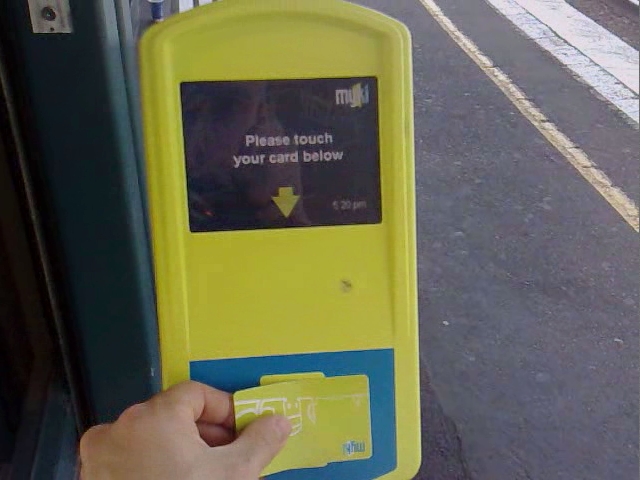
How do I touch on and touch off?
Touching on and touching off allows the system to know what to charge you, although touching off on trams is optional (see below).
Touch on your Myki ticket at a reader as you enter the station, or as you board the tram or bus. Touch off the ticket at a reader as you leave the station, or leave the tram (optional) or bus.
You must place the ticket flat on the reader. Don’t “swipe” it or move it around, because the reader will take longer to respond or not read the card at all.
The card must be within about half a centimetre of the reader, but preferably touching it. It will usually work from inside a wallet or bag, especially if the Myki ticket is in the closest pocket, but this isn’t guaranteed. It will often not work if you have other cards in your wallet which use similar technology (an RFID chip), because that confuses the reader.
Do I really need to touch on every time?
You need to touch on every time you enter a station, tram or bus to ensure your ticket is valid for travel, even if you have already touched on somewhere else for the particular journey you are undertaking.
In reality, you must touch on the first time you use a ticket for a particular journey, to set its expiry date and time. Not doing so is fare evasion.
There is an exception to that, however. You don’t have to touch on or off if you travel on a tram entirely within the “Free Tram Zone” which covers Melbourne’s CBD and Docklands. There is a map of the Free Tram Zone here.
But if your journey starts or finishes outside the boundaries of the Free Tram Zone, you must touch on your Myki in the normal way to make sure you have a valid ticket.
You must touch on when boarding a bus, even if your ticket is already valid for that journey, so that the bus driver knows you have a valid ticket. You must also touch on when boarding at railway stations if your destination is a gated station, otherwise the gates at your destination may not let you out, and you may have to queue for staff assistance.
You should also touch on and touch off if you are travelling on a Myki Pass outside the zone(s) you have paid for.
Do I really need to touch off every time?
Except on trams (see below), the official line is yes. If you don’t touch-off, you may get charged a default fare, which may be more than you’d otherwise pay.
The default fare is charged when the system doesn’t know where you got off the train/tram/bus, and it assumes you might have gone to the end of the line (on a tram/bus) or to the last stop of the longest line on the system (metropolitan trains).
In other words if you don’t touch-off on buses and trains the Myki system may assume you took a two-zone trip, and charge you for it. If this is the correct fare anyway (for instance you’ve travelled on a train from the CBD to a Zone 2 station) then you will not be charged anything extra if you do not touch-off, and so you can choose not to do so.
As noted above, you still need to touch on and off if you are travelling on a tram entirely within the Zone 1/2 overlap, if you want to ensure that you pay the cheaper Zone 2 fare.
The default fare does not apply to Myki Pass if you touched on (started your journey) in your nominated zone. In other words, if you have a weekly/monthly/yearly Pass on your Myki card, there is no need to touch off when travelling in the zone(s) covered by the Pass.
The government says it gets useful statistics about travel patterns if people touch on and touch off every time. However, they supposedly got useful statistics with the old Metcard system, as well as through manual surveys, but that hasn’t stopped services getting very crowded due to a lack of forward planning and investment over the past few years.
Why don’t I have to touch off on trams?
There was an obvious likelihood of congestion on trams resulting from the number of passengers trying to touch on and off at busy stops. Therefore, all tram routes were modified to be within Zone 1 (areas formerly in Zone 2 only are now all within the Zone 1/2 overlap), and so you do not have to touch off on a tram if you are only travelling within Zone 1, because the default fare on trams is a Zone 1 fare only.
However, if you travel on a tram entirely within the Zone 1/2 overlap, which only occurs right at the end of routes 75, 86 and 109, you do need to touch off before you alight to ensure that you are only charged the cheaper Zone 2 fare.
Do I get charged for another 2-hours if I touch off after the expiry time?
No. Your Myki ticket is valid as long as you touch on at a station, or board the tram or bus, before the expiry time.
I heard weekly/monthly/yearly Passes aren’t valid on weekends.
That is not true. They are valid on weekends, but only in the zones you’ve paid for.
A single-zone weekly/monthly/yearly Metcard used to be valid in both Melbourne zones on Saturdays and Sundays. That benefit has been withdrawn under Myki. The government argues that is necessary in order to be consistent with regional areas, and yet no regional area has the $6.30 weekend daily fare cap which is available in Melbourne.
The result is that Myki Pass users must pay extra if they travel into another zone. But their total fare will attract the $6.30 weekend/public holiday cap, and what has already been paid towards that is taken into account.
Why does the information displayed on the reader vanish too quickly for me to read it?
The information showing your card balance, and the amount deducted for your journey, will be displayed for as long as you hold your card to the reader, so hold it up for longer if you want to check that information. However, some of the new card readers on railway station barriers do not display any information about the status of the card.
You can also use a Myki Card Vending Machine or a Myki Check (blue-colured) machine to find out the balance on your card.
I’ve heard that a Myki card has an expiry date.
The validity of a Myki card expires four years after purchase, but the expiry date is not shown on the card itself. Note that the expiry date is set when the card is first loaded with credit, so if you buy a pre-loaded card that has been lying around for a while before you bought it, the expiry date may be less than four years away.
You can find out when your card expires by checking it on a Myki Card Vending Machine or blue Myki Check machine. These are situated at railway stations, some tram platform stops, and some major bus interchanges. You can also find out a card’s expiry date by ringing 1800 800 007 and quoting the card number.
If you have registered your Myki you can find out the expiry date by logging on to your account via the PTV website. People who have registered their Myki will be reminded of the imminent expiry by PTV before the expiry date.
Before your Myki expires you can go to any staffed railway station or PTV Hub to get a free replacement card. The remaining balance on your old card will be transferred to the new one. If your Myki has a negative balance, you will have to top-up to a positive balance as part of the replacement process.
If you can’t get to a location where you can replace an expiring Myki, there are two other ways doing so. Sixty days or less before the expiry date, you can either apply online or download an Application for Replacement Myki.
If your expired Myki is registered, the replacement card will also be automatically registered. However, if you have auto top up linked to your expired Myki, you will have arrange auto top up again for your new card.
Does Myki Money always give me the best fare?
Provided everything works correctly, it does give you the best daily fare, by charging you the cheapest possible fare for each trip, and upgrading it automatically, for instance from a 2-hour Zone 1, to a Daily Zone 1+2 — whatever is cheapest for your day’s travel.
But if you use it every day, the system does not automatically upgrade you to a cheaper 7-day Pass or a 30-day Pass etc. Myki Pass must be pre-loaded to attract the cheaper periodical fare.
I heard you have to pay extra if the train is late.
No, not on trains, but you may be affected if you want to make use of the 2-hour fare and you catch trams and buses.
Under Myki, your ticket is valid as long as you start your trip (that is, touch on at the station, or as you board the tram or bus) before the 2-hour travel time expires.
This is only a problem when using trams and buses, because you only touch on as you board. When using trains you can enter the platform and touch on before the expiry time, no matter how late the train you are catching might be.
If you are going to travel for more than 2 hours it makes no difference to you, but if you are trying to make a couple of short trips using a bus or tram in a single 2-hour period, with no other travel that day, you will be charged the daily fare if the bus or tram arrives late, after your 2-hours has expired.
What’s the use of compensation being paid as Myki Money, when I have a Myki Pass?
Monetary compensation for poor service delivery can only be claimed if you have travelled for 10 or more days with a Myki Pass that is for 28 days or longer.
When Yarra Trams, Metro Trains or V/Line miss their monthly performance targets, you can claim compensation. Given the electronic nature of the Myki system, it is ridiculous that getting compensation is a manual process, involving filling in a form and posting it. It seems obvious that the system is designed to discourage passengers from getting the compensation they are owed.
Compensation is paid as the Myki Money equivalent of the zones covered by the Pass, rather than extending the duration of the Pass.
There are several ways to make use of the Myki Money compensation:
- Use it after your Pass expires. Note, however, that if you have another Pass loaded on your card, the Myki system will always use that first if it is valid for your trip.
- Use it for travel in other zones, including V/Line journeys.
- Request that the compensation amount is added to a different Myki card, such as a family member’s card, or a second card that you use. This option is on the form.
- Pay for your next Myki Pass using Myki Money. This is done by putting enough Myki Money on your card to pay for the Pass, then choosing the option on vending machine to buy a Pass with Myki Money. Unfortunately this option appears to only be available from vending machines.
Is Myki switching us to distance-based fares?
No. The zone system is being retained.
Hong Kong, Singapore and a number of other cities use fares based on how many kilometres you travel. Myki fares continue to be based on zones (which now spread across a lot of Victoria) and duration (2-hour, daily, etc.) of travel.
The PTUA believes that distance-based charging has some disadvantages − it may lead to higher fares, and it is quite confusing, because you might not know how much you’ll be charged before you travel.
How do ticket inspectors and V/Line conductors check tickets?
There is little information printed on the Myki card itself, and no obvious way of telling whether you have validated correctly or not. Authorised Officers (ticket inspectors) and V/Line conductors use hand-held devices that can read the cards.
Has Myki slowed things down?
In some situations.
Station exits during the evening peak have become congested as train-loads of people queue to touch off. The new “Vix” readers which have been installed across the Myki system have eased that problem to some extent, particularly on buses, on which the older Myki readers were notorious for their slow and inconsistent response times.
The government’s decision not to include single-use tickets as an option might have speeded-up bus operations, but that is at the expense of occasional users who do not have a Myki, or passengers who have forgotten to have their Myki with them.
Touching off was made optional on trams, to avoid delays. Whether delays occur depends to a great extent on how quickly the readers respond, and how many there are. It is worth noting that London’s buses and trams were both switched to a flat fare system, requiring no touch-off, because delays during disembarking were causing problems.
Does Myki work properly?
Virtually every aspect of Myki’s introduction was poorly handled. The PTUA flagged a number of design and implementation problems with Myki that needed fixing, and we are continuing to give feedback to Public Transport Victoria.
The biggest drawback with the Myki system is the state government’s unexplained decision not to make single-use tickets available, meaning that every public transport user must have a Myki card, loaded with sufficient credit, to be able to travel. This makes things extremely difficult for tourists, for new and occasional public transport users, or for passengers who have problems with their Myki, and it will be a further source of fare evasion.
As soon as Myki began operating, the PTUA asked that different sounds be introduced for a touch on and a touch off. Instead of that, we got the totally unnecessary introduction of a double beep for concession passengers.
Opportunities for buying and topping up cards are still too limited, especially for tram and bus users.
There have been a number of instances of people mistakenly “touching on” at the blue Myki Check machines, rather than the actual Myki card readers, and then being fined for not having touched on. We asked PTV to make changes to the relevant hardware and software which will make this less likely to occur.
Watch the system very carefully to ensure you’re being charged correctly. Keep a close eye on the Myki readers as you use them, check your transactions on the Myki Check machines (the blue machines in stations and some trams stops) at vending machines and/or via the PTV web site, and ring 1800 800 007 or contact PTV online if you suspect you have been overcharged.
Was Myki worth the money?
Probably not. Although the Myki system brings some benefits, including better access to cheap fares, these are eclipsed by the enormous cost of the system.
Few passengers wanted a new ticket system, and the PTUA argued that, for a fraction of the cost, either the previous Metcard system could have been updated, or a cheaper Smartcard system bought from elsewhere. The money saved could have been spent on more staff, trains, trams and buses. But the change has happened, so we’re providing feedback to Public Transport Victoria to try and improve the outcome for passengers.
Further questions?
Email office at ptua.org.au with your questions. We’ll endeavour to find out the answers and post them back here.
If you want to read all the fine print yourself, it’s contained in the Victorian Fares and Ticketing Manual. Be warned, the Manual is over 100 pages long.
Public Transport Victoria has posted some useful information on its web site, which you can read here.
You can ring PTV for information, on 1800 800 007 (6 a.m. – midnight daily).
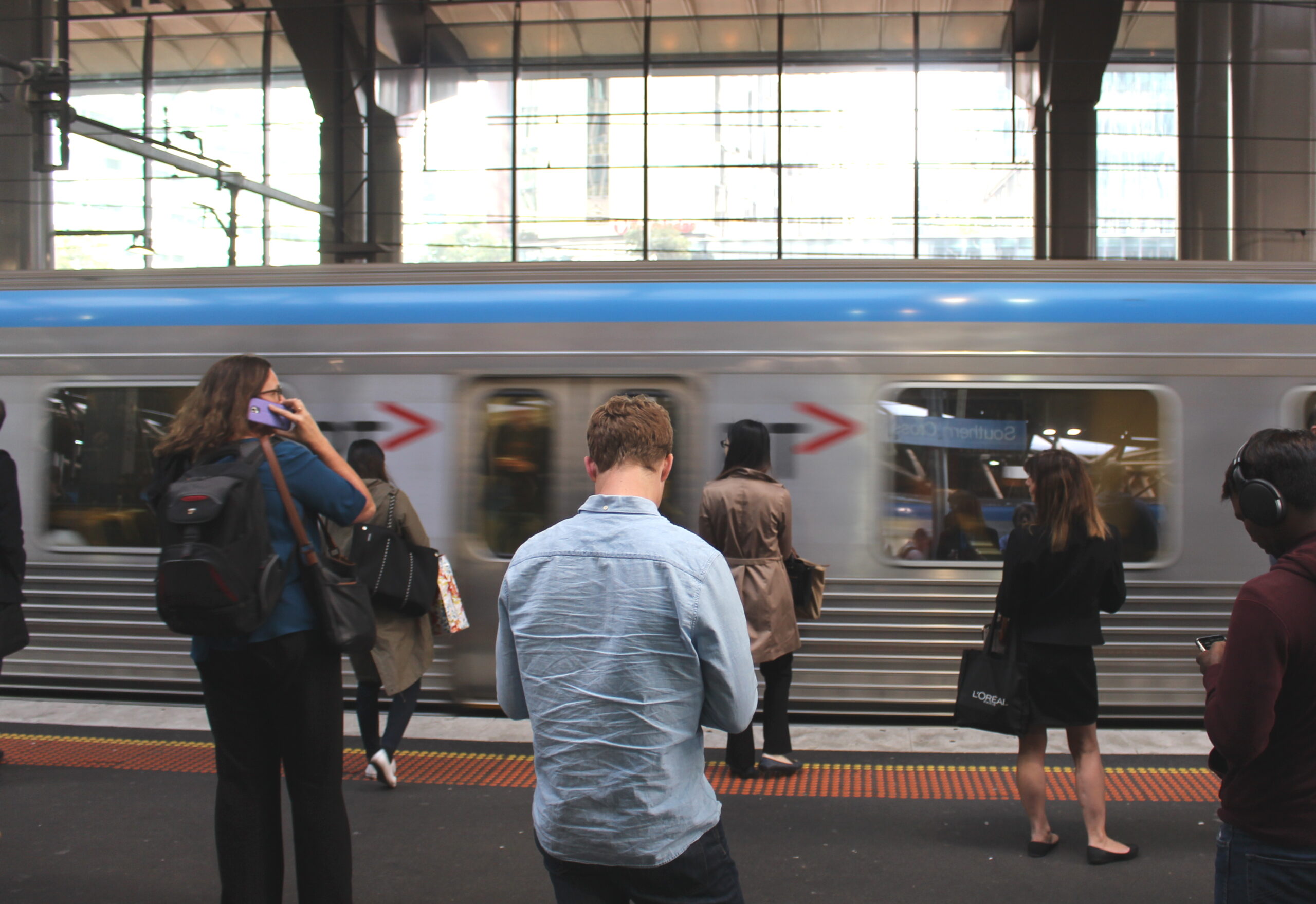
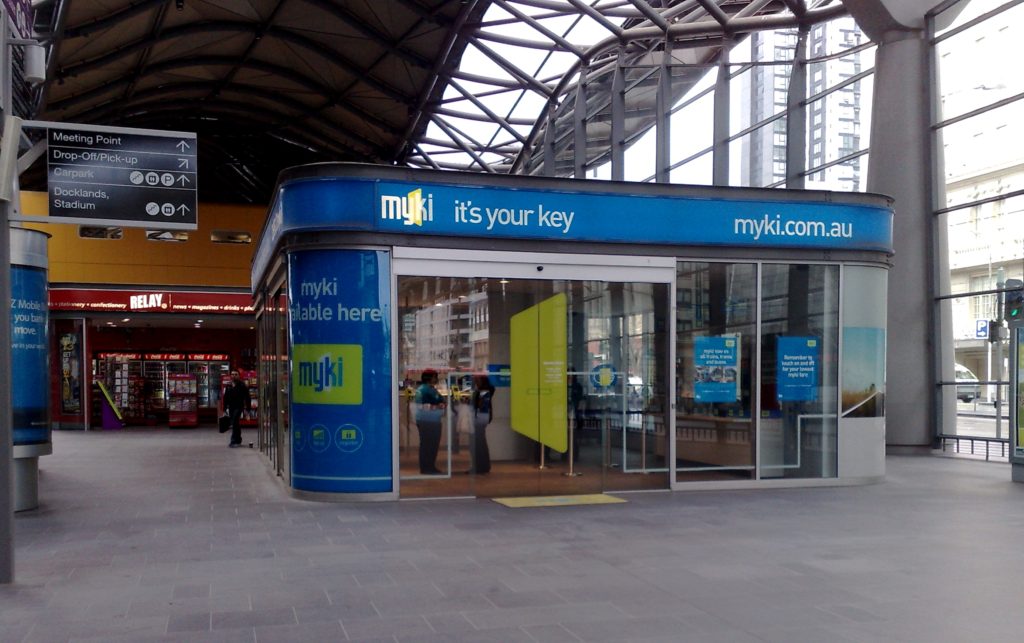
You can also go to a PTV Hub to get assistance. There is one near the Collins Street entrance of Southern Cross Station (pictured). There is another Hub on the ground floor of the PTV headquarters building at 750 Collins Street, Docklands, about 500 metres from Southern Cross station. That Hub can perform more operations than the one at Southern Cross. For example the Collins Street Hub includes the Pass Office, which issues the various forms of free travel passes which are available on the public transport network.
There are also PTV Hubs in Geelong and Bendigo.
What is the PTUA anyway?
Founded in 1976, the Public Transport Users Association is the recognised consumer organisation representing passengers of all forms of public transport.
We are a non-profit, voluntary organisation, with no political affiliations. If you want to help support our work, please join us. You get five newsletters per year, as well as access to cheap Yearly tickets, and you’ll be helping the campaign for better public transport in Melbourne and around Victoria.