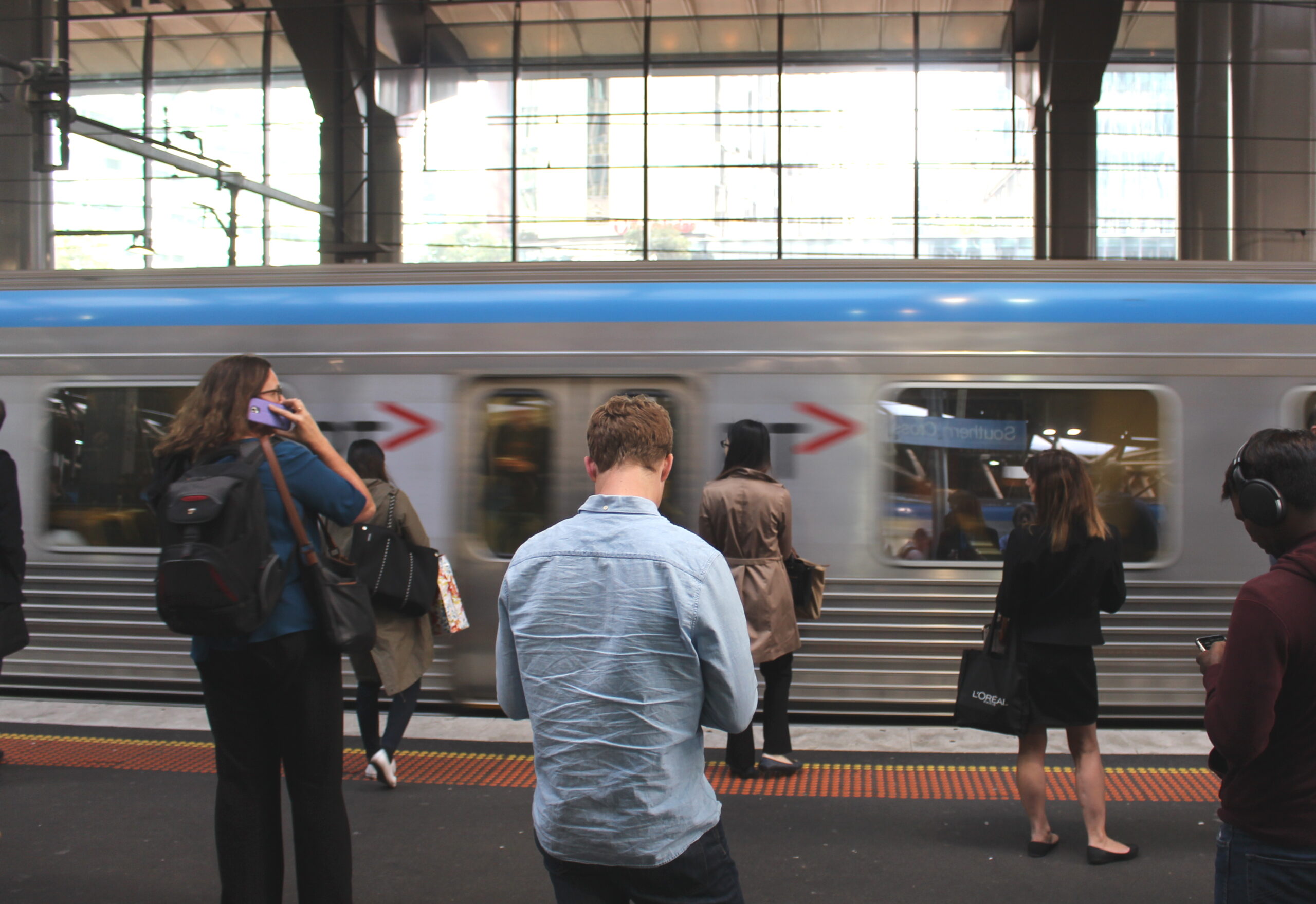
Since every public transport user is also a pedestrian, the creation of a high quality walking environment is essential for connecting with public transport services.
Though public transport can never provide a complete door-to-door service, the PTUA advocates a standard of service which ensures that nobody in Melbourne is located more than a few minutes’ walk from a frequent, full-time public transport route. Passengers must be able to walk in relative ease and safety to and from public transport if they are not to be deterred from using the service.
At present, there are too many impediments in the walking environment which deter people from using public transport. Such barriers range from busy roads with inadequate crossing facilities and traffic signals with cycle phases unfavourable to pedestrians, to perceptions of personal safety because of poor design of the walking environment, especially at night and when there are few other people around.
These barriers are capable of being overcome, though often it calls for a change in attitudes prevailing among transport planners, principally those at a state and local government level, who have major responsibility in this area.
Access to trams
Various measures have been applied to avoid conflict between tram users and motor vehicle drivers. These include:
- The “safety zone”, which places an obvious barrier between the tram and the footpath, and confines waiting passengers to a narrow space between the tracks and the traffic.
- The Superstop. This is larger, sheltered, raised to allow easier access to trams, especially low floor vehicles, and includes seating and other facilities. While these are more convenient and comfortable for passengers, they restrict access from kerbside to trams by providing only entrances at each end, leading to pedestrian congestion at peak times.
In the absence of safety zones or Superstops, traffic must stop to allow the movement of people on and off trams. While this can be more convenient for able-bodied public transport users, this arrangement has its own perils. With the onus on the motorist to avoid passing a stationary tram, negligence on his or her part poses the single greatest danger to users of public transport, and better education and active enforcement of these laws is vital.
A partial solution to this is the ‘easy access’ stop. This has no barrier between the kerb and the tram, but the road pavement rises like a tabletop speed hump, giving a strong visual and physical signal to drivers that they should reduce speed and give way to passengers. These stops help reduce the danger posed where tram passengers rely on car drivers to give way to them, though it does not negate the need for education and active enforcement of the road rules.
The PTUA sees the conflict between tram passengers, cars and trucks as part of the problem of road danger in general. We favour the elimination of “safety zones” together with traffic calming initiatives (such as lower speed limits, footpath widening, and tree planting) on all tram corridors to place public transport users and motorists on a more equal footing – and in line with the Vicroads “Smart Roads” strategy of prioritisation for public transport along tram routes.
On wide streets, safety zones can be upgraded to Super stops, with some minor redesign to better facilitate pedestrian movement between the stop and the kerb. On narrower streets, passengers should access trams from the kerb, with complementary measures such as easy access stops and rigorous enforcement of road laws requiring cars to stop.
Where possible, streets with trams should be more fully “pedestrianised”, as with the Bourke Street Mall and Swanston Street, to create a safe and pleasant environment for pedestrians, public transport users and cyclists.
Tram stops have traditionally been located at intersections for maximum ease of access for those walking from nearby streets and interchanging between services. For this reason, the PTUA opposes the relocation of stops away from intersections.
We also oppose the wholesale reduction in stops for the purpose of maintaining on-time running, particularly in high-density areas such as central Melbourne. This is a self-defeating device which makes tram travel less attractive. There is ample scope to improve running time by the judicious application of tram priority measures, which are often capable of being introduced without detriment to other road users.
Traffic calming and pedestrianisation
There is a clear demand from communities across Victoria for quieter, safer residential streets and pedestrianised activity centres, suggesting that the time for traffic calming – or slowing down traffic in the interests of pedestrians, cyclists and public transport – has come. Improved facilities for pedestrians will help bring about an increase in public transport patronage, as people find it easier to walk to the nearest bus or tram stop than to hunt for space in a busy car park.
Traffic calming has been limited so far to residential streets and shopping centres, while main roads often receive the opposite treatment to facilitate greater traffic flows. This has been done to encourage motorists to keep to arterial roads rather than using minor residential streets, but it has resulted in a worsening of conditions on the main roads, particularly for residents, pedestrians and cyclists. To achieve the full benefits of traffic calming, it should be applied on an area-wide basis, including main roads as well as the adjoining side streets. Some shopping streets have now started to receive this treatment, with demonstrable benefits for pedestrians and shoppers.
Reviewed: September 2015