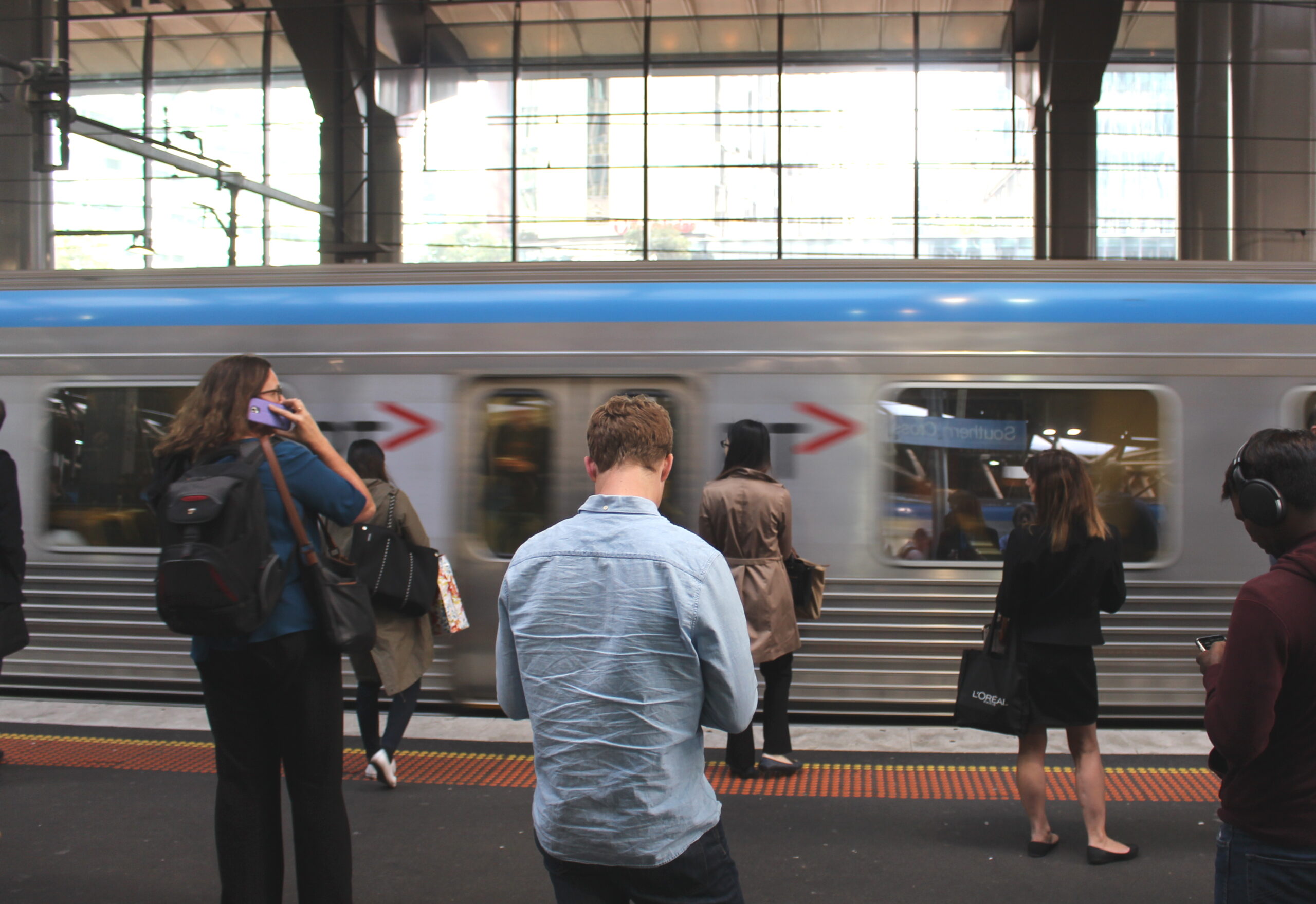
Essential to a well-patronised and efficient public transport system is the presence throughout the system of staff who can assist passengers, create a safe travelling environment, and ensure fare compliance in a non-threatening manner. As recently as the 1990s Melbourne’s public transport system had such a presence, in the form of friendly conductors on every tram and staff at every railway station.
Ever since these staff were sacked in 1998, public transport operators have had to compensate by hiring nearly 600 ticket inspectors, who perform only one of the functions of real staff and in a manner that creates an atmosphere of conflict rather than service – as confirmed by two Ombudsman’s reports in the past decade.
I travel on public transport at least twice a day every working day, and have personally witnessed the most disgusting, condescending, over-bearing and heavy-handed behaviour from the agents of Yarra Trams, who think that shouting at a non-English-speaking tourist who is evidently very embarrassed and confused about what ticket to buy is appropriate behaviour.
—Justin Lodge,Mr Premier, the people have spoken, The Age, 12 March 2006
Removing the conductors had a sinister effect on the cultural feel of Melbourne. Instead of conductors, we now have inspectors. What does this say? It seems that as a city, we would rather fine you for being wrong than help you to be right.
—Louisa Deasey,Melbourne’s trams are a hostile place, The Age, 15 July 2008
Last week I witnessed two inspectors hounding a young woman with obviously poor English for about six stops…. From her answers, which were consistent, she was clearly on the wrong tram. There was an uncomfortable silence on the tram as young and old listened to the aggressive and relentless questioning, which culminated in the young woman being fined, having her ticket confiscated and being left quietly in tears as the whole troop of four inspectors left the tram triumphant, chests stuck out, like the Texas Rangers of old. We don’t deserve such goings on and we don’t need them in this day and age and in this country.
—Stephen Dinham (Camberwell), The Age, 3 August 2008
Complaints about authorised officers nearly doubled in the past 12 months and have increased every year for the past five years. Of the complaints, 31% were about intimidation, 22% about the use of force, the rest were largely about officers not listening or acting aggressively. One of the biggest causes for complaint was that officers travel in groups of up to eight and stand in a circle around people if they don’t have a ticket. It’s a certain indication something is going terribly wrong, if people feeling less rather than more safe with high numbers of public transport staff on their trains….
[The Ombudsman] says it is clear from the many allegations of assault that authorised officers need
better guidance about the use of force, including a clear and appropriate definition for excessive or disproportionate use of force. That statement appears to be a very understated way of saying high numbers of commuters are being unlawfully assaulted by people employed by their government.
—Luke Williams, Crikey, December 2009
A writer to The Age compares this to trying to run a newsagency on an ‘honour system’, where people take what they want and put money in a box at the counter. Anyone would be a fool to think they could run a business this way, let alone a community service. And taking a confrontational approach to enforcing payment, rather than just having counter staff to take people’s money, would just make things worse:
Hiring a group of thugs to randomly patrol my shops, harassing and assaulting those they suspect of not intending to pay will only make for an unpleasant experience for the shoppers and most likely be treated with the cynicism it deserves.
—Brian Pearce, letter to The Age, 16 September 2005
Despite our sorely-missed ‘connies’ being featured at the 2006 Commonwealth Games Opening Ceremony, and a Leader Newspapers survey in September 2007 finding over 90% support for returning staff to stations, our public transport bureaucracy has resisted all calls to restore tram conductors and station staff. The claim is it would be far too expensive – notwithstanding the fact that fares nearly doubled in the 10 years after staff were withdrawn. (In response to media questioning back in 2002, then Transport Minister Peter Batchelor said restoring full staffing “would take the price of a daily zone one ticket from $5.10 to $7 and we’re not prepared to do that.” But in the last year of conductors, a daily zone one ticket cost just over $4; ten years later the same ticket – without conductors – cost $6.80.)
The true cost of restoring full staffing is nowhere near what has been suggested, as a quick calculation shows. Approximately 1,400 passenger-service staff would be required to staff our 500 trams and 210 stations. Of these around 200 are already in the budget (‘Customer Service’ officers employed directly by the government). This leaves 1,200 to be funded from additional revenue. Allowing $73,000 per employee for salary and on-costs (based on the median wage plus 15 per cent) gives a gross cost of $88 million per year to restaff the system.
For comparison, the effective cost to the public of implementing the Myki smartcard system in its first decade was $135 million a year – and much of this cost will continue to be incurred into the far future as the remaining ‘bugs’ in Myki are fixed. PTV’s annual reports confirm that the ongoing cost of running Myki is now around $100 million a year.
But there are a number of factors that would cause the net cost of staff to be much less than $88 million:
- Fare evasion still costs the system over $50 million a year. Realistically we can expect that these staff would cut fare evasion by 80% by making it difficult to evade fares, easy to buy a ticket, and defusing the ongoing informal campaign of civil disobedience. That’s $40 million a year saved.
- With conductors on trams and staff at stations, the other 400-odd roving ticket inspectors would become largely redundant. Reemploying three-quarters of these as tram conductors means $20 million less need be spent on inspectors each year.
- Increased patronage, through improvements in actual and perceived safety, cleanliness, slightly faster trams, fewer unpleasant incidents and general commercial goodwill, will boost revenue by an amount that is difficult to quantify.
- Costs to the operators and law enforcement authorities would be reduced through fewer fare evasion offences, fewer court appearances and settlements, reduced vandalism, and lower maintenance costs for Myki machines.
We expect, therefore, that the net cost of restaffing the system would be around $20 million a year. This is a conservative figure and is likely to overestimate the true cost. But it is consistent with the estimate of $15 million a year by RMIT transport economist John Odgers, in a study commissioned by the Sunday Age in July 2008. (While Odgers only considered the return of tram conductors, these constitute around 80 per cent of the total staff requirement.)
The government, meanwhile, continues to insist that automatic ticketing and the Myki smartcards make staff unnecessary. This is quite wrong, as this page explains, and is also contrary to the experience in other cities. Amsterdam, for example, removed conductors from its trams when it introduced automated ticketing in the late 1980s, only to reintroduce them (on all but three routes) when fare evasion jumped to 15%. After conductors were returned in 1991, fare evasion fell from 15% to 1%. Amsterdam has smartcards similar to Melbourne’s, but has kept conductors to ensure quality of service is maintained.
In terms of service [conductors are] very important. We attach great value to customer service… [and] safety of our passengers and, of course, the driver. The fact that there’s a conductor on the tram also means that the driver can concentrate better on his job to drive the tram safely and on time.
—Marjolijn van Bilderbeek, spokeswoman for Amsterdam tram operator GVB, quoted in The Age, 20 July 2008
Full staffing would also help the Myki system work better, through the provision of mobile top-up facilities and the option to buy short term tickets (which can be implemented on existing Myki consoles using the same hardware now used to issue paper receipts).
The return of conductors and station staff is completely affordable. If it were to be funded through a fare increase, the increase would be less than the 10% GST that applies to public transport tickets. It would likely be comparable to the 3% increases that are routinely applied each year to adjust for inflation. But it does not need to be funded through increased fares: cost savings and cuts are never passed on in the form of reduced fares, after all. We don’t increase the Medicare levy every time we fund a new initiative in public health, and this should be the same.
Ticket inspectors make me feel like I live in a police state. I’d choose public transport much more easily if I felt safe, with all stations manned all the time, and conductors there to help, rather than ticket inspectors there to check up and accuse.
—Kerry Dawborn (Cockatoo), The Age, 14 July 2008
Last modified: 13 November 2015