Myth: ‘Real’ people don’t use public transport
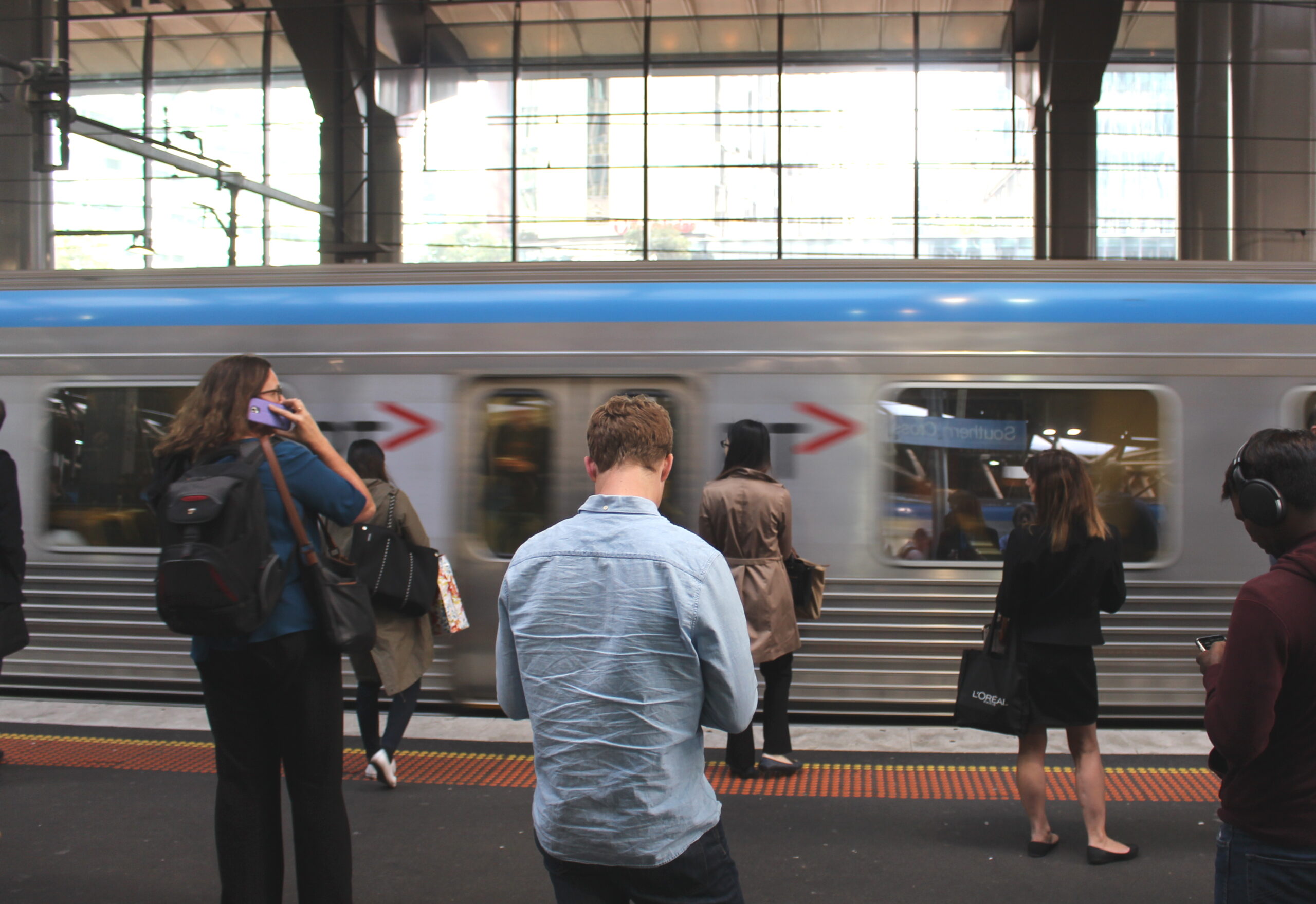
Fact: Public transport is just another way of getting around, and where it is competently planned and managed is the travel mode of choice for large numbers of people, regardless of creed, social status or political affiliation. People just like you, the reader of this page.
Any man who rides a bus to work after the age of 30 can count himself a failure in life.
—attributed to Margaret Thatcher, former British PM
What will I do for public transport? I will improve the economy so you can find good enough work to be able to afford a car.
—George W Bush, US President, campaign speech
Not too long ago it was common for users of Melbourne’s barely-functional public transport system to be taunted by friends and work colleagues with all-too-familiar jibes: “You’re not a dinkum Aussie if you don’t drive a car” or “Public transport, that’s something they use in socialist countries” or “Get sold any good drugs this morning?”
Such taunts were usually made in good humour and would be harmless enough, were it not for the fact that some of the bureaucrats and managers responsible for planning our transport system seemed to take them, like Maggie Thatcher did, as entirely serious comments on people who use public transport. Judging by their ongoing failure to provide a decent service, many of our public transport managers still do.
When public transport use in Melbourne nosedived in the postwar era, the public transport planners and managers (with the possible exception of the now-defunct Tramways Board) responded not by improving the quality of their service to compete with the car, but instead by giving up on the idea of public transport as a conveyance for ‘normal’ people. Like the ‘Protectors of Aborigines’ a century ago, they regarded the people under their care as fated to die out in favour of a ‘superior’ alternative, to be provided in the meantime with a barely adequate service at minimal cost to taxpayers.
Thus, for nearly half a century the view has persisted in Melbourne’s transport planning circles that public transport is only for
- peak-hour central-city commuters, and travellers to major events, where capacity constraints dictate that not everyone can get there by car;
- school children, who aren’t yet old enough to have a driver’s licence;
- those who are incapable of driving cars due to a disability;
- the desperately poor, who can’t afford to drive cars; and
- those few eccentric citizens who persist in using public transport despite cars being ‘obviously’ a better way to get around.
Little wonder that public transport in Melbourne had trouble being taken seriously!
This attitude is still prevalent in North America, on account of the poor standard of public transport in many cities and suburbs there. Thus, an editorialist in Waterloo, Canada writes:
Any coherent discussion of public transit in Waterloo Region has to begin with the fact that we operate our transit system largely for the benefit of students and the poor…. Its main purpose is to provide transportation for local residents who can’t afford cars. It therefore seems reasonable to assume the region’s $819-million light rail transit system will attract a similar clientele. Low-income residents and students will use it. Taxpayers who never ride it will pay for it.
—Peter Shawn Taylor, Waterloo Record, March 2010
What lies at the base of this is what psychologists call the fundamental attribution error. When we try to understand why other people do what they do, we jump to the conclusion that it’s because of the kind of people they are, rather than the situation they find themselves in. This is despite the fact that we can usually see quite clearly how our own situation influences our own actions.
So the fallacy arises: people who use public transport do so because they’re the kind of people who use public transport; therefore, improving the system will only attract more of the same kind of people. Since there are only a limited number of poor people, school children and so on, it seems to follow that improving public transport is pointless. Transport planner Jarrett Walker explains how the same misconception underlies terms like ‘car culture’, and ‘European public transport values’. Meanwhile it distracts us from recognising the fact that the use of cars, or public transport, is mostly a rational response to the comparative quality of roads and public transport services.
Queensland Department of Main Roads policy and planning deputy director, Mark Cridland…. said Brisbane motorists refused to move closer to public transport hubs or change the way they travelled.
So what does this tell us? We have a deeply entrenched car and suburban life culture.—Brisbane Times, 16 November 2010
Coming back to Melbourne, it’s easy to find evidence for this attitude among transport bureaucrats, both before and after privatisation. Here are just a few examples.
Example 1: People have money to spend? Let them drive cars
When the Southland shopping centre expanded its premises in the early 1990s, owner Westfield canvassed the option of building a new station on the Frankston train line, which runs right past Southland but where the nearest station was over a kilometre away. A new station made commercial sense for Westfield, as having people come by train would avoid the need for a lot of extra car parking. Before long it had gained the support of the community, the council and the PTUA (for whom it had been long-standing policy). The only opponent was the Public Transport Corporation, who complained that the extra station would add to their trains’ running time – and besides, ‘real’ people would continue to drive there anyway. The Southland expansion duly went ahead without the station and with greatly expanded car parking instead. It took over two decades more before Southland eventually got its station in 2017.
Example 2: People want hassle-free transport? Let them drive cars
When automated ticketing was introduced in 1997 it rightly infuriated many ‘real’ people, who were getting a greatly reduced service thanks to the sacking of tram conductors and station staff, and being made to put up with a round of endless ticket revalidation and equipment failures into the bargain. While many people blame the Kennett Government for this, the plans were being made in the bureaucracy even before Kennett was elected, and date from the aftermath of the ‘scratch ticket’ debacle in 1990. Our public transport planners long ago formed the view that public transport users were not ‘real’ people and so didn’t deserve a system staffed by real people; the result was the abortive scratch tickets, and later the Metcard system and its Myki successor.
Another example of the government’s contempt for public transport users occurred in September 2006, when work on the EastLink tollway ran half a day late and closed the Ringwood train line for the entire Monday morning peak. Though tens of thousands of Melburnians were delayed for hours, the government claimed that was not its concern, saying it was a matter between passengers and the private train operator. But the system would have been far better prepared for unforeseen delays if the government treated public transport as vital infrastructure (like power lines and freeways), rather than just something that makes a few unimportant commuters grumpy when it fails.
Example 3: People have finished their uni degree? Let them drive cars
In the late 1990s the Moreland City Council began an investigation into Sydney Road trams and how they could run more effectively. The tram operator was wondering what all the fuss was about, because (they said) the North Coburg tram was used mainly by students going to and from Melbourne University, and the Sydney Road section of the route was of lesser importance. But when the council did their own survey, they found more people used the North Coburg tram on the Sydney Road part of the route than on the Parkville section around the university. In fact, this tram route has always been extensively used by ‘real’ people for all manner of activities – including many for shopping purposes, something transport bureaucrats of the 1990s would never have thought possible but for this reality check.
Example 4: People have medical conditions or young children? Let them drive cars
Melbourne’s big city hospitals are readily accessible by public transport, and this transport option is frequently used by both outpatients and visitors, helping keep pressure off their car parking facilities. But many suburban hospitals are poorly connected to the public transport network, and as a result suffer enormous problems with car parking. In the case of Dandenong Hospital, this has gone so far that VCAT in 2013 refused a permit for much-needed additional consulting rooms because they came at the expense of 11 parking spaces. According to The Age on 9 February 2014, VCAT gave as its reason that most of the patients were pregnant women or people with babies or young children who would be unlikely to rely on public transport
. This could be because the bulk of available transport options, especially on weekends and evenings, involve walking several hundred metres to either Stud Rd or James St, rather than catching one of the handful of buses that call at the hospital itself. In a sensible planning framework, there would be processes for land-use planning authorities such as local councils to seek improvements to local transport services in such situations.
Example 5: People don’t want needless obstacles in their way? Let them drive cars
Many supposed ‘improvements’ made to the public transport system since privatisation in 1999 have come at the expense of passenger convenience. These include the removal of direct access from Swanston Street to Melbourne Central station; the obstacle course that pedestrians must now negotiate at the Melbourne University tram terminus; and the ongoing obsession with removing tram stops to speed up trams by making passengers walk further. We sympathise with motorists who are told to get out of their car and walk an extra 200 metres to where they used to park, but since public transport users are supposedly not ‘real’ people they are supposed to dutifully obey when told to walk the extra distance.
Example 6: People like to travel in comfort? Let them drive cars
Amazingly, even the near-doubling of train patronage between 2005 and 2009 failed to shake the bureaucracy out of its old attitudes. A confidential briefing document for then-new private operator Metro, as reported by the Herald Sun on 2 June 2010, stated that Melbourne train passengers would tolerate standing for up to 45 minutes on an express train. When the government was asked about this, they blamed the words on out-of-touch bureaucrats
. Indeed, experience would suggest that our planning bureaucracy is more interested in writing off train overcrowding as a fact of life, than in responding to it with additional services and system upgrades.
The reality: It’s all about planners’ attitudes
In world cities where public transport is taken seriously, people from all walks of life use it and rely on it for many of their day-to-day travel needs. The difference is not in the people themselves (who also own cars and like using them), but in the attitude of government planners toward public transport, and the expectations about public transport quality that have evolved in these cities. Far from being a characteristic of ‘socialist’ countries, the cities where public transport is most used by ‘ordinary’ people are also the very centres of global capital: New York, London, Zurich, Hong Kong. Ignorant statements by economic-rationalist politicians notwithstanding, appreciation of public transport has nothing to do with one’s preferred political ideology – merely a concern with the efficient use of scarce resources.
Malcolm Turnbull, until recently Australia’s richest politician and sometime Prime Minister, has certainly had no qualms about putting in a good word for public transport, even if he was notoriously less outspoken in the leader’s chair:
It is one of the highest priorities for our major cities to improve public transport. I get around almost invariably by public transport and I find it quite impractical to drive.
—Malcolm Turnbull, quoted in The Age, 18 April 2006
[F]ormer investment banker and Liberal MP Malcolm Turnbull….has argued for members of Parliament to be given a chance to swap their entitlement to a taxpayer-funded car for a public transport allowance.
Trading in the car entitlement, worth about $45,000 plus petrol and servicing costs, could save taxpayers money as well as reducing the impact on the environment, he says.
At the moment, the system gives people a financial incentive to drive a car rather than take public transport and help with sustainability,he said yesterday.From both a cost and environment point of view, it seems counterproductive. Common sense would suggest, particularly in city areas, that you change the rules to eliminate that disincentive….—
Turnbull offers MPs a ticket to ride, The Age, 2 November 2005
We complain bitterly about crowded roads but do not provide enough of the only thing that can be relied upon to get people off the roads – efficient and reliable mass transit… Good public transport is critical but has been neglected for too long. It has an important social benefit. Cities dependent on cars discriminate against the old, the poor and the young.
—Malcolm Turnbull, address to Western Sydney population summit, July 2010
The problem that occurs when planners cease to take public transport seriously – as in the suburbs of Melbourne – is that the situation becomes self perpetuating. People start to see fewer and fewer people like themselves on public transport, cease using it themselves, and advise their children not to use it. Eventually a kind of stigma attaches to the very fact of being a public transport user, as the ‘fundamental attribution error’ creeps in. This can be most clearly seen in Geelong, where traders have petitioned against bus stops being located outside their businesses!
Fortunately, this vicious cycle can be reversed. If it is perceived that ordinary people use the system, more and more people will be attracted to it as confidence in the system increases and the stigma dissipates. It becomes no longer tenable to say that public transport is the exclusive preserve of a car-deprived underclass. This has been seen in Perth where public transport, once shunned by the populace, has become respectable again as a direct result of the government taking it seriously and investing in genuine service improvements.
Both principles can be seen at work when comparing the perception of Melbourne trams with that of Melbourne buses. In cities with well-planned public transport, the kind of vehicle isn’t a major factor in people’s willingness to use the system. But in Melbourne, trams have historically been operated by a government entity (the Tramways Board) with a strong sense of public purpose and a healthy respect for its passengers; whereas buses were operated by private companies with a condescending or even hostile attitude to their passengers. In recent years the bus industry has made a real effort to improve its record, and buses are a lot better than they used to be. But their history has nonetheless led to clear differences in performance: trams are frequent, well-patronised, have high cost recovery, and have earned an iconic status as symbols of the city; buses are infrequent, poorly patronised, have low cost recovery, and are regarded as the ugly ducklings of the transport system.
People are not stupid. If public transport is the best option to get them somewhere, many people will use it, as attested by the crowding every peak hour on Melbourne’s trams and trains. A good proportion of these people are the ‘real’ people that are perceived as not using public transport. It is for non-commuting trips that most ‘real’ people will not consider using public transport, not necessarily because they ‘won’t’ use it, but because it simply isn’t a reasonable option for the trip, due to poor frequencies, long waiting times, and limited hours of operation.
But it need not be the case that only those with no choice use public transport. In many European and North American cities, public transport is much better patronised than in Melbourne, not only in absolute terms, but as a proportion of trips.
The difference between these cities and Melbourne is not that people don’t own cars, but that they don’t use them as much. This is because these cities have good public transport systems which give their residents an option to leave their cars at home. For most Melburnians, who have a car at their disposal, it is cheaper, easier and quicker to use that car for any given trip than to use public transport. Unless you are lucky enough to live near a station or a tram, you have to put up with slow, infrequent and tortuous bus routes, which often do not run in the evenings or weekends.
Last modified: 9 December 2018