In its Environmental Effects Statement for the CityLink project in the early 1990s, VicRoads invented a ‘public transport alternative’ designed to cast the new road in a favourable light. It claimed this alternative would require capital expenditure of $3.5 to $4.5 billion, three times as much as CityLink itself.
Most of the cost was for two items, a north-south rail link in the mid-Eastern suburbs (which is not needed because few people travel long distances in this corridor, and the Burke and Glenferrie Road trams could be upgraded to provide the necessary links) and additional platforms at inner city stations like Richmond. Given that Richmond station was expanded from 6 platforms to 10 in the late 1950s, and patronage in the 1950s was almost twice as high as in the 1990s when VicRoads produced its EES, it should have been clear that no additional platforms were needed.
The idea that our public transport system is ‘full’ and we need to spend billions on new rail lines before trying to shift existing car trips to public transport is another road lobby fairy story—albeit one that’s cleverly exploited the recent population explosion in Melbourne. It’s easy to conflate the struggle to provide adequate service to new growth areas in our western suburbs, where there are genuine infrastructure shortages (most obviously the single track to Melton), with the failure to provide service in vast swathes of Melbourne suburbs that have existed for the best part of a century. These latter suburbs are generously provided with rail infrastructure compared to the new growth areas, yet are still often only provided with trains every 20 or 30 minutes outside peak hour, while local buses are even less frequent.
Although we do need to continue extending our rail and tram networks—both to serve new growth areas and to fill strategic ‘gaps’—Melbourne has long had the largest urban rail system in the world relative to population, and the largest tram system outside Europe. Notwithstanding our recent urban growth, the problem especially outside peak hours is still a shortage of passengers, not of tracks.
For the Scoresby Freeway EES in 1997, the road lobby had a more cunning strategy. Here there was (and still is) a clear public transport alternative, the main components of which are a train extension to Rowville and a tram extension to Knox City. Independent estimates at the time put the cost of the entire public transport package at a fairly modest $240 million. However, when it became evident that the public transport alternative might have a better benefit-cost ratio than the freeway, the government planners had it removed from the list of options being considered. To kill it off once and for all they inflated the costings, so that the cost of the Rowville line alone went up fourfold from the consultant’s original estimate!
Public transport projects can always be made to look expensive through ‘gold-plated’ costings. Except in Perth, which built its 70km Mandurah rail line in 2005 for an overall cost of about $18 million per kilometre (including rolling stock), rail projects in Australia typically have a cost at least two to three times that of equivalent projects in Europe (which can scarcely be said to have a more accommodating industrial environment). The stand-out example is the 57km Gotthard Base Tunnel, a rail tunnel bored deep under the Alps and one of the most challenging engineering projects in the world to date. Its final cost was just under 10 billion Swiss francs—close enough to $10 billion Australian dollars. It is almost embarrassing to compare this with the $11 billon budget for Melbourne’s Metro Rail Tunnel (valuable as this project is), let alone the $16 billion budget for the North East Link tollway.
Whenever something’s costed it seems to be extravagantly costed so it always looks overpriced, but when the thing is built it’s the cheapest that works. There is this mentality I have found that they could do it better for less, but they don’t. It’s very, very frustrating. I don’t know what it is, this kind of apologist attitude. The road guys have things well-costed and ready to go and they lobby for them, but for rail they seem to dodder along a bit.
—John Kirk (former head, Australasian Railway Association), in The Age, 13 June 2009
Confirming it isn’t just in Melbourne that public transport projects get burdened with ludicrously high costings, there are ample examples from Sydney:
When the go-ahead for NSW RailCorp’s proposed 13 kilometre line to Sydney’s south-west growth centre was announced in June last year (characteristically, it’s since been indefinitely deferred) the estimated cost was $1.36 billion—more than the price of [Perth’s 72 kilometre] Mandurah line. How could a simple 13 kilometre project over unchallenging greenfield terrain with just two new stations, a stabling yard, reconstruction of Glenfield station and connections to the Southern Line possibly set the taxpayer back $106 million per kilometre?…
The inflated estimate skews benefit-cost analysis so that the project appears uncompetitive with motorways—an outcome neatly coinciding with the dominant philosophy of state governments… [But] if the project is cancelled, its estimate becomes the baseline for the next estimate. It takes little imagination to see that this process, continuously repeated, would put costs on an escalator….
Had the estimates…been merely 130 per cent of comparable projects… the excess might be legitimately explainable by regional differences in materials, geology, labour costs, land acquisition (where applicable) but at 200 per cent such an anomaly requires detailed public explanation. Three hundred per cent and above seems inexplicable and possibly scandalous.
—Gavin Gatenby (co-convenor, EcoTransit Sydney), Crikey, 26 March 2009
Poorly controlled budgets help feed the related myth that rail lines cost more to build than freeways; as we explain on that page, Perth’s new rail lines are being built for much less money, and for substantially less cost than freeways. The difference is that Perth’s projects are being planned and managed by those with experience in railway building, while in Melbourne and Sydney our engineers have only just started regaining experience with anything other than roads. After the Glen Waverley line was completed in 1930—nearly a century ago—the 1970s City Loop was the only new rail build of any significance until the Regional Rail Link began construction in 2009.
I am an experienced project manager [in NSW]…. I have been absolutely flummoxed and gobsmacked at each step along the way by the need to revisit basic design and project proposals seemingly endlessly…. Endless delays occur due to the non-availability of key staff in civil design, signals, survey – whatever.
—Online comment, Crikey, 26 March 2009
From what I understand of the process used in WA for the Mandurah line, their Public Transport Authority put together a team that spent two years doing a very detailed masterplan before going to tender. This no doubt minimised the possibility of later revisions, project politics and muddle-through…. the job was carefully broken down into packages for competitive tendering…. The government was keen to
spread the work around.I was told that the tendering process was largely the work of an engineer co-opted from their roads department. This last fact is interesting because these days roads departments have a huge body of continuous experience in managing projects, whereas rail authorities…. have only discontinuous experience, simply because such a small amount of rail gets built and so many projects are cancelled.
—Reply by Gavin Gatenby, Crikey, 27 March 2009
Outside WA these cost overruns and budget blowouts are rarely acknowledged, but careful attention to government media releases tells the story.
The Minister for State and Regional Development John Brumby today announced the Bracks Government will build a $1.5 million pedestrian railway overpass at Wandong and Heathcote Junction.
—Victorian Government media release, September 2006
A new $4.2 million pedestrian bridge over the Melbourne to Sydney railway line at Wandong is now complete providing a safe crossing for walkers and cyclists.
—Victorian Government media release, August 2009
Capacity Crisis? What Capacity Crisis?
Although the myth of huge infrastructure requirements and costs originated with the road lobby, it gained real momentum with frequent claims by the Department of Transport and private operators that our entire suburban rail system is ‘at capacity’ and cannot support extra peak services unless we spend billions of dollars building additional tracks.
These claims had little to do with Melbourne’s recent population growth, arguably predating it by several years. For example, just prior to the 2008 Global Financial Crisis—when the city’s annual growth rate had only just pushed above 2 per cent—a spate of media stories expressed alarm that high petrol prices would spell the city’s doom by tempting more motorists to use public transport, thereby ‘crippling’ the system:
SPIRALLING petrol prices could cripple the state’s public transport system as motorists choose to leave their cars at home and take the train to work….
“It looks like prices at the pump are likely to continue their upward trend, which may well force more motorists to rely on a public transport system that is already close to capacity,” [survey author Jonathan] Kerr said.
“If petrol prices do rise rapidly and 29 per cent of Victorian commuters suddenly turn to public transport the ramifications could cripple the system.”
—“Victorian motorists could abandon cars if petrol price rises”, Herald Sun, 23 April 2008
Melbourne’s public transport system is bad enough as it is. There’s no way the system could cope with hundreds of thousands of additional commuters.
—John Roskam (Institute of Public Affairs), The Age, 4 June 2008
Switching to public transport simply won’t meet the need. According to [Association for the Study of Peak Oil] Australia’s convenor, Bruce Robinson, no Australian city has anywhere near enough public transport capacity to handle even a quarter of existing car travellers if they needed to use buses and trains instead.
—David Salt, G Magazine, 31 August 2009
Such statements found a receptive audience among train passengers forced to put up with peak-hour overcrowding that reached severe levels on all lines between 2008 and 2010. But this overcrowding was not the fault of passengers, nor was it due to insufficient tracks, as we’ll explain shortly. The main reason for it was poor management—in particular the decision taken in the early years of privatisation to scrap virtually all Melbourne’s spare trains, when a glance at the CBD employment forecasts would have shown they were needed to handle growth in peak-hour travel to the city.
When reading breathless claims like the ones above it pays to remember that Melbourne’s public transport system still has more tracks per head of population than most others in the world, yet even now still caters for barely 10% of trips. The idea that such a system would be ‘crippled’ by more passengers (with its implied suggestion that we cannot afford to have people switch from cars to public transport, even if they wanted to) would not be taken seriously in places with well-run systems.
As another page demonstrates, if a randomly-selected number of people, equal to the current number of daily public transport patrons, were to switch from car to public transport tomorrow, this would not nearly double the number of train passengers arriving in the CBD in peak hour. Many of these extra passengers would not be using trains at all, and of those that would, most would travel only a few stations. It should not come as a surprise to anyone that the further out one lives, the less important the CBD is as an employment destination. This simple truth is obscured by the fact that current public transport use is dominated by the relative minority who do work in the CBD.
The real irony, though, is that the claims of a capacity crisis almost never focus on the real bottlenecks in the system, namely the remaining single-track sections on the Altona, Upfield, Hurstbridge, Lilydale, Belgrave and Cranbourne lines, most of which are quite short and could be duplicated for relatively little cost. Instead the focus is on grandiose white elephants like third or fourth tracks to Dandenong, involving high costs but relatively little benefit (and none whatsoever outside peak hour).
To see why we don’t have a capacity problem, even in peak hour, it suffices to examine the historical evidence. The map shown below was prepared for the 1929 Melbourne Town Plan, at a time when train patronage was almost as high as it is now, despite the population being smaller. Shown next to each line are the peak and off-peak train frequencies (for metro services only; some lines also carry country services but these are not counted in the frequencies shown).
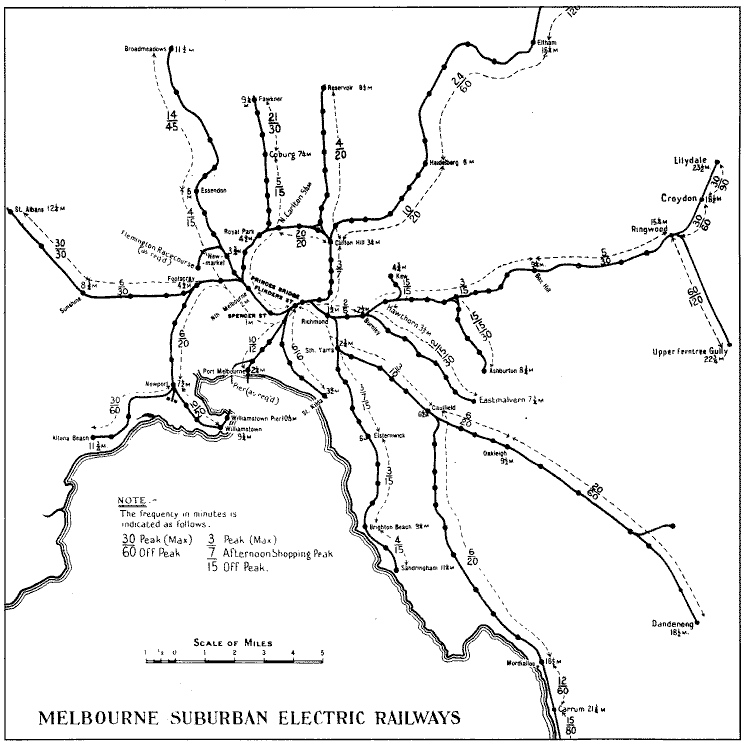
A number of important facts can be read off this map. Note first that even in 1929 trains ran as frequently as every three minutes to Clifton Hill, Brighton Beach and Box Hill – all on double-track lines (the third track to Box Hill came much later). It is also evident from the difference between peak and off-peak frequencies that journeys were just as concentrated in peak periods as they are now (largely because most non-work journeys were made on foot or by bicycle). This refutes the argument that our supposed capacity problems stem from a need to carry more people in peak periods than in earlier times.
The frequencies shown on the map were those achievable with 1920s-vintage signalling and manual crossing gates. Since then, all lines have been upgraded with improved signalling (such as the South Morang, now Mernda, line in 2011). This allows trains to run every three minutes or better on all but a few lines, even if we can’t quite achieve the 60-second headways of the London Underground or the 30-second headways of the Paris Metro.
Not only did trains often run more frequently in the past: they also carried many more passengers overall. Back in 1929, the Sandringham line carried 30 million passengers, a fact proudly noted in that year by Bradshaw’s Guide to Victoria. This compares with just 6 million passengers in 1991, and around 15 million today. Even with recent patronage growth, the number of trips on the entire Melbourne train network, with its 15 lines, is around 8 times the patronage on just one branch line in 1929.
Lest anyone think we’re singling out the Sandringham line for special treatment, we can look at some system-wide figures. Based on current figures for train patronage and population, Melburnians make on average about 50 train trips a year. In 1950 the equivalent figure was 157 train trips per person. Of course, the population in Melbourne was only 1.3 million in 1950 compared with four times that now. But it still means that in 1950 the rail system was able to carry almost the same number of passengers as it does now, without any of the infrastructure improvements that have been built since 1950, including the City Loop, the expansion from 6 to 10 platforms at Richmond, and quite a few third tracks (such as that between Caulfield and Moorabbin on the Frankston line, built in the 1970s).
Historical figures on journeys to work confirm the general findings. While there was a recovery in train patronage between 2006 and 2010, this came from a level which according to the Census was still below those seen in the postwar era.
| Journeys to work by train in Melbourne | ||
|---|---|---|
| Year | Commuters | Source |
| 1951 | 153,000 | Melbourne Metropolitan Planning Scheme, 1954 |
| 1964 | 147,000 | Melbourne Transportation Study, 1969 |
| 1981 | 113,000 | Australian Bureau of Statistics: 1981 Census |
| 2001 | 118,500 | ABS: 2001 Census |
| 2006 | 142,500 | ABS: 2006 Census |
In short, if the rail system in 1950 could carry half a million passengers a day and 150,000 in peak hours without any of the extra tracks built since that time, we should already have been, in 2006, in a position to do much, much better.
Instead, even in 2005 we had private operators telling us via news reports that
Melbourne’s rail network cannot carry many more trains. And more passengers slow boarding times, contributing to late running.
—Melbourne Leader, 30 May 2005
Not to mention Transport Ministers saying that
We couldn’t operate our train system now if it wasn’t for the underground loop.
—Transport Minister Peter Batchelor, Melbourne Leader, 30 May 2005
Beneficial as the underground loop and other rail improvements have been, what such statements really betray is how much management expertise has been lost to Melbourne’s public transport system in its half-century of decline. The loop itself was originally planned on the basis that CBD trips by train would double, and require 181 incoming suburban trains between 8am and 9am, compared with 108 peak hour trains in 1964 and 116 trains in 1929. Even leaving out the now-defunct St Kilda and Port Melbourne lines, the projected capacity with the loop in place was 168 trains per hour, compared with 95 in 1964—plus capacity for expansion beyond the design year
.
Yet in 2005 when the above statements about capacity were made, Connex timetables showed 87 incoming trains between 8am and 9am, which was even less than in 1964. New timetables from 2011 have restored services just surpassing the 1964 level of service, with 114 incoming trains. Even if we add in the V/Line services boosted by the ‘Regional Fast Rail’ project, the total number of suburban plus country trains (131) in the busiest hour of the peak today is only three-quarters of the projected capacity for suburban trains in 1969.
As the table below shows, not only have we been failing for decades to use a substantial portion of the city loop’s planned capacity; right up until 2009, some individual lines that were said to be ‘at capacity’ were still running fewer trains than before the loop was built! Little wonder overcrowding was at unbearable levels!
| Trains arriving at Flinders Street, 8:00-9:00am | |||||
|---|---|---|---|---|---|
| Line | 1964 | Projected in 1969 | 2005 | 2009 | 2012 |
| Belgrave / Lilydale / Alamein | 18 | 27+ | 20 | 21 | 22 |
| Clifton Hill (Doncaster) | – | 4 | – | – | – |
| Craigieburn | 9 | 10 | 6 | 9 | 10 |
| Frankston | 12 | 28+ | 10 | 11 | 13 |
| Glen Waverley | 5 | 8+ | 8 | 8 | 9 |
| Hurstbridge | 9 | 11 | 8 | 8 | 9 |
| Pakenham / Cranbourne | 11 | 24 | 10 | 13 | 14 |
| Port Melbourne | 5 | 5 | – | – | – |
| Sandringham | 11 | 10+ | 6 | 7 | 8 |
| South Morang (Epping) | 5 | 6 | 4 | 5 | 7 |
| Sydenham (St Albans) | 4 | 9 | 5 | 7 | 8 |
| St Kilda | 8 | 8 | – | – | – |
| Upfield | 3 | 4 | 3 | 3 | 3 |
| Werribee / W’town / Altona | 8 | 12 | 7 | 8 | 11 |
| Total suburban trains | 108 | 181 | 87 | 100 | 114 |
| Excluding St Kilda / Port Melbourne | 95 | 168 | 87 | 100 | 114 |
| Albury / Seymour | 2 | 1 | 1 | 1 | |
| Ballarat / Melton | 2 | 2 | 4 | 4 | |
| Bendigo / Sunbury | 2 | 2 | 5 | 6 | |
| Geelong | 1 | 2 | 4 | 4 | |
| Gippsland | 2 | 1 | 2 | 2 | |
| Total including V/Line | 117 | 95 | 116 | 131 | |
(Source: Melbourne Transportation Plan, 1969 and V.R. working timetables. Metro and V/Line timetables, effective October 2005, November 2009 and April 2012. V/Line arrivals are counted at Southern Cross. For consistency, Werribee trains are counted as suburban services throughout, though these operated as diesel ‘country’ trains in 1964. ‘+’ indicates projections are ambiguous and may be higher than stated.)
The bottom line is that only the Glen Waverley and Sunbury lines are currently running at the capacity the 1960s rail engineers had in mind when they designed the city loop. All other lines feeding the city loop are falling short of planned capacity, some of them well short. And the table doesn’t even tell the whole story, because in the early 1960s the Epping, Frankston and Sandringham lines ran more trains in the evening peak than the morning peak.
A large part of the reason for the apparent ‘CBD capacity crisis’ in the late 2000s is that operators have only since then begin operating the city loop in the way originally intended, with many trains running direct to Flinders Street. Prior to 2009 it was insisted that nearly every train should run through the loop, a policy which wasted about one-third of the real capacity available.
By reverting to something closer to the original city loop operating plan, some relief to peak-hour overcrowding was seen, with the number of ‘load breaches’ declining significantly between 2009 and 2012. But due to the need to rebuild the fleet after the premature scrapping of the Hitachi trains, this occurred on some lines sooner than others: it was only in 2012 that the Hurstbridge line was restored to its 1960s level of service!
Of course, capacity constraints aren’t only claimed for the city loop: individual suburban lines are also said to be suffering from capacity constraints. The reason has to do with express running. Expresses have been used on Melbourne’s train network since the 19th century, and Bradshaw’s assures us that peak-hour expresses were certainly used on the Sandringham line in 1929. But as soon as one mixes express trains and stopping trains on the same track, extra space has to be allowed in front of the express train, otherwise it catches up with the stopping train and gets slowed down.
The map above shows that even with expresses, the Sandringham line managed 3-minute frequencies in 1929. But the Dandenong and Werribee lines are longer than the Sandringham line, hence the ongoing claims that these lines can’t sustain a mixture of express and stopping trains at nearly the same capacity without a separate track for the express trains.
However, the reduction in capacity depends on how long the express runs on shared track actually are. Consider first the Dandenong line. An express run from Caulfield to Oakleigh shortens travel time by three minutes, so requires an additional three-minute gap between it and the previous stopping train. An express run from Caulfield to Dandenong, on the other hand, requires an eleven-minute gap. If such ‘super expresses’ were commonplace, it would be impossible, without extra tracks, to maintain a high frequency while also serving intermediate destinations.
There are, however, many ways of arranging train stopping patterns so that passengers benefit from express running but capacity is not jeopardised. In Perth, for example, trains on the Northern Suburbs line alternate between two different express patterns, which together ensure that all stations are covered. There are 16 trains per hour on the Northern Suburbs line (compared with the Dandenong line’s ‘congested’ 15 trains per hour and the Werribee line’s 11 per hour), and planners there are confident that even more capacity is available. Building entire new tracks is just one of many possible ways to fit in more trains, incurring the highest cost but requiring the least planning effort.
In a 2005 textbook, transport planner Vukan Vuchic notes that three-track lines (such as we built in Melbourne to cater for express running) are rare internationally because they offer little flexibility relative to their cost. The scheduling methods described in this same textbook can be applied to the Dandenong line to achieve capacities of 20 trains per hour, close to the theoretical maximum of 24 per hour allowed by Melbourne’s signalling system. The ongoing upgrades to signalling as part of the Metro Rail Tunnel project will allow capacity to be improved further, even though the Metro Tunnel itself provides no additional tracks on the east side of the city. (The underground tracks from South Yarra actually substitute for two existing tracks between South Yarra and Flinders Street, which will be redundant once the project is complete.)
If textbook arguments fail to convince, we can look at international practice.
- In Japan, planners face the exact same problem of operating double-track ‘main lines’ with a mixture of stopping trains, expresses, long-distance services and freight. The minimum performance benchmark there is 15 trains per hour each way (or one train every four minutes). This applies regardless of the service mix; but if one particular kind of service predominates, then planners expect to be able to run even more trains.
- The busiest subway line in Rome (an ordinary two-track railway much like ours, only underground), carries 500,000 passengers a day. On the day of the Pope’s funeral in 2006, this one Italian train line carried one million passengers: more than are carried per day on Melbourne’s entire train system.
- The Paris RER ‘A’ line (again a two-track railway, but with more signalling) carries 55,000 passengers an hour, more than a million per weekday, and 273 million in a year. This one line exceeds Melbourne’s entire train passenger load by around 10 per cent.
- During the 2010 Winter Olympics in Vancouver, its three SkyTrain lines carried as many as 600,000 trips in one day. SkyTrain is sometimes described as a ‘light rail’ system, but on this occasion it carried more passengers in one day than the entire 15-line Melbourne train system. One of these lines (the Canada Line) carried 207,000 passengers: as many as Melbourne’s entire system carries in peak hour!
However one looks at it, the supposed capacity shortage is revealed to be a management problem, not an infrastructure problem. This is underlined by the actual history of the Werribee line after the Regional Rail Link opened in 2015, and express trains to Geelong ceased to use this line. Four years later, the promised boost to peak-hour train services from 6 or 7 per hour to 12 per hour had still not been delivered, not due to lack of capacity but a failure at management level to plan and fund the changes, and manage the flow-on implications to other lines.
In conclusion, if there really is money available to spend on new tracks, the priority should be
- new projects strategically targeted at growth areas, such as the Melbourne Metro 2 tunnel to further boost capacity in the south-west and the northern suburbs, balancing the capacity already provided in the south and east;
- the remaining single-track sections in the network, which make the provision of reliable high-frequency services difficult to impossible whether inside or outside peak hour; and
- network extensions to areas that currently have no train services at all, no matter how fast or frequent.
Once the real bottlenecks have been fixed it may then be appropriate to consider additional tracks for faster express trains. Needless to say, all of this should be undertaken by competent and skilled planners, every one of whom is worth more than their weight in gold-plated steel rails.
Last modified: 11 July 2019