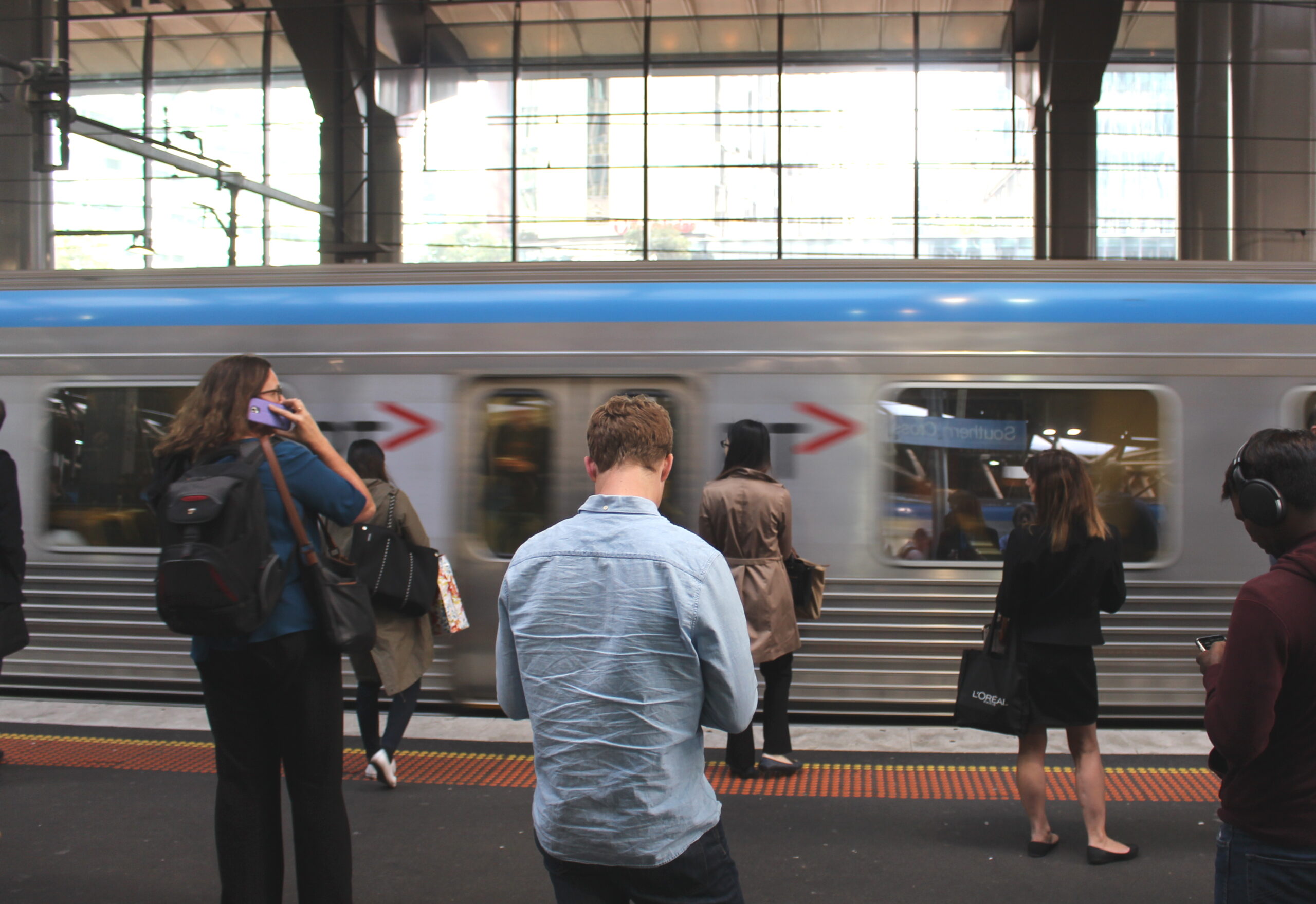
When road planners try to shore up the myth that people won’t be persuaded to leave their cars at home, one of the more common arguments they find is that public transport can’t take people from door to door, the way cars supposedly do.
This argument falls down on two points: first, cars don’t take people from door to door any more than public transport does; and second, most people will tolerate walking distances sufficient to bring them within reach of a reasonably comprehensive public transport network, no matter where in the suburbs they live.
The vast majority of motorists do not have the luxury of parking their car right next to their chosen destination. At a large shopping centre like Chadstone, parking spaces extend more than 200 metres from the nearest entrance, which may itself be a further 200 metres from the desired destination. For less mundane trips, such as a Saturday football outing, people will tolerate walking even further. Carlton fans in the 1990s would park at the Zoo and walk to what was then Optus Oval a kilometre away; MCG patrons similarly will park in Victoria Parade.
Available evidence suggests that even habitual motorists, on a typical journey, will tolerate walking up to 500 or 600 metres between vehicle and final destination. A public transport network that brings every point of the metropolis within 600 metres of a tram or bus route will provide a similar level of convenience, assuming the route itself has plentiful stops, spaced so as to keep the parallel walking distance as small as practicable. This is supported by a 2019 study by Victoria Walks using VISTA data, which found the median distance actually walked to public transport in Melbourne is 721 metres to a railway station, 390 metres to a bus stop and 360 metres to a tram stop. Since these are median distances, half of all public transport users actually walk further than this.
While most of greater Melbourne is well beyond 700 metres from any railway station, a much greater proportion is within 600 or even 390 metres of a bus stop, even with the bus network as it exists today. So why does Melbourne’s admittedly extensive network fail to satisfy people? Not because it doesn’t go past everyone’s front door. The reason is poor frequency and bad connections, as explained in other PTUA documents. This is evident even in the inner suburbs that government planning documents describe as “public-transport rich”.
Consider Kate, who lives in Viva Street off Tooronga Road in Glen Iris, halfway between Wattletree Road and High Street. Kate is 20 metres from a bus stop and 300 metres from each of two tram routes. Kate takes the tram to work in the city, and Chadstone shopping centre is a short bus trip away. But in the evenings and on weekends the buses run only once an hour, and evening trams run at 20 minute intervals. It is the prospect of a one-hour or 20-minute wait on a cold and dark roadside that has made Kate decide to use her car for all but the trip to work. Doubtless if the trams and buses ran with reasonable frequency at the times Kate wanted to travel, she would make more use of them. It doesn’t bother Kate that the tram doesn’t go past her front door, as long as it runs frequently enough and is within reasonable walking distance.
Last modified: 13 February 2020