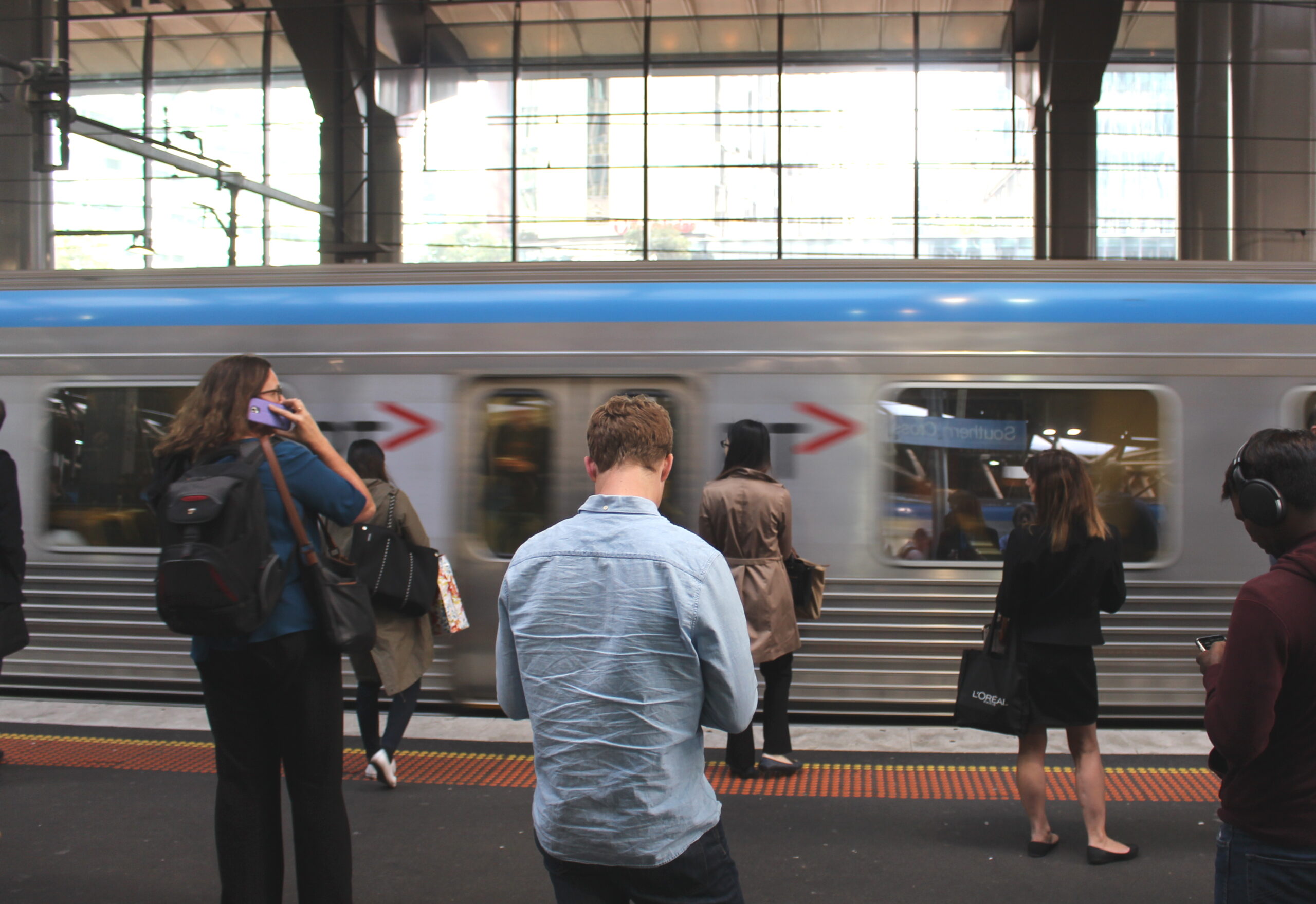
Most prominent among public transport issues in Victoria in the past decade have been the so-called ‘Fast Trains to Regional Centres’ and the reliability crisis with metropolitan trains. Such prominence has been given to the speed of the new country trains, and to tallying up Metro cancellations and delays, that it is easy to think slow speeds and poor reliability are in fact the biggest problems facing public transport in Victoria, and are the principal deterrent to higher public transport use.
Of course, speed and reliability are important. People will not use public transport if journey times are much slower than by car, and vehicle speed is a factor in this. And reliability is something that should ‘just happen’ in a functioning public transport system. The Swiss take high reliability and punctuality for granted, but even Melbourne’s trains achieved close to 100% reliability throughout most of the 1920s, when patronage was almost as high as it is now.
Nonetheless, even the fastest train in the world run to Swiss precision is of no use if you have to wait two hours for it to arrive. Most Victorians do not use public transport; the reason for this is not that trains run at 80kph rather than 120kph, or that trains sometimes get cancelled (though this certainly helps contribute to the negative perception of the system that most people don’t use). The reason is simply that public transport in Melbourne and country Victoria does not offer the same level of convenience as car travel: the main reasons for this are long waiting times (due to low frequencies), long transfer times (due to low frequencies and bad planning), lack of service at the times people want to travel (due to low frequencies and bad planning) and the complete absence of services in many suburban areas and regional cities (due to bad planning).
How do we know this? In part, from surveys conducted as part of the Regional Fast Rail project itself. In 2000, as part of its feasibility study, the government surveyed people who do not currently use V/Line trains, asking them to nominate the reason why. The results were as follows:
| Reason | Percent responses |
|---|---|
| Need a car while in Melbourne | 45 |
| Destination not accessible by PT | 17 |
| Train is too expensive | 14 |
| Travelling by car is cheaper | 10 |
| Train is too slow | 7 |
| Concerned about personal safety on train | 3 |
| Not enough trains to Melbourne | 3 |
| Do not live near a station | 1 |
| Total | 100 |
(Source: Department of Infrastructure, Fast Rail to Regional Centres Feasibility Study, Executive Summary.)
While speed was given as the reason for not using trains only 7 per cent of the time, the inadequacy of urban public transport was cited 62 per cent of the time, and high fares 24 per cent of the time. In the government’s report these figures were given without comment, but they actually lead to quite strong conclusions. When people travel from regional Victoria to Melbourne, their destination is frequently in the suburbs rather than the CBD, and is often not within walking distance of a railway station. Since even people who live in Melbourne find public transport almost impossible to use under these conditions (particularly outside peak hour), it is not surprising that country Victorians think the same way. It also doesn’t help that V/Line fares are high even by European standards, and Europeans get a far superior service for their money.
(It’s also true that ‘Not enough trains to Melbourne’ was given as a reason only 3 per cent of the time. But this doesn’t mean that country Victorians aren’t concerned about frequency. When contemplating a journey, people think first about how they are to actually reach their destination, and (mostly) form a decision to drive the car on that basis. Only if they conclude the journey is actually possible by public transport do they then consider whether there’s a train leaving at the time they want to travel. And so in most cases it is the need for the car at the destination, and not the lack of trains, that registers foremost in people’s minds.)
My concern was [fast rail] seemed to me to be a project with a high cost but limited benefits….I wondered, in fact, if five or six minutes saving in journey time was really what people at the end of the line wanted. I would have thought regularity and more frequency of service would have been better.
—Dick Roennfeldt, former director (until 2001), Victorian Office of Major Projects, quoted in The Age, 11 June 2005
Subsequent experience has vindicated the opinions of planners like Dick Roennfeldt. In 2006, the Regional Fast Rail project shifted its emphasis from speed to service frequency, and the number of peak hour services more than doubled on the upgraded lines. The result was phenomenal: patronage grew to such an extent that planners scrambled to find even more trains to run. Respondents to V/Line customer surveys now nominate ‘convenience’ as the main reason for using trains. The main question occupying rail planners now is how to fit an unprecedented number of regional trains into the Melbourne rail system – and the Regional Rail Link project means the government’s preferred solution will now add to travel times!
In conclusion, to doubt that service frequency is important to passengers is to ignore overwhelming evidence about what works in attracting people to public transport. Operators must also do what they can to speed up services, while reliablity and punctuality can (and must) be assured by competent management. But concentrating on these basic operational factors to the exclusion of everything else can only limit the potential of public transport.
Last modified: 31 March 2012